

Spring 2005. Our daughter Molly had graduated from 5th grade at Sligo Creek Elementary School in Silver Spring, Maryland. We had taken a number of father-daughter excursions over the years. I don’t remember what subject matter had prompted her curiosity about the Civil War, but there we were looking out over vast smooth hills under a bright hot spring sky.
We were visiting, at her suggestion, Antietam National Battlefield where, 143 years previous, a great and horrible battle took place.
We parked near a forested area, and there were other swaths of trees further out and all around. In some way we were typical tourists. We started at the visitor center, studied dioramas of the landscape and the troop movements, read summaries of the battle, death tolls of wars over the years, and learned a little about what happened in our nation’s history that brought 132,000 men to this site on September 17, 1862.
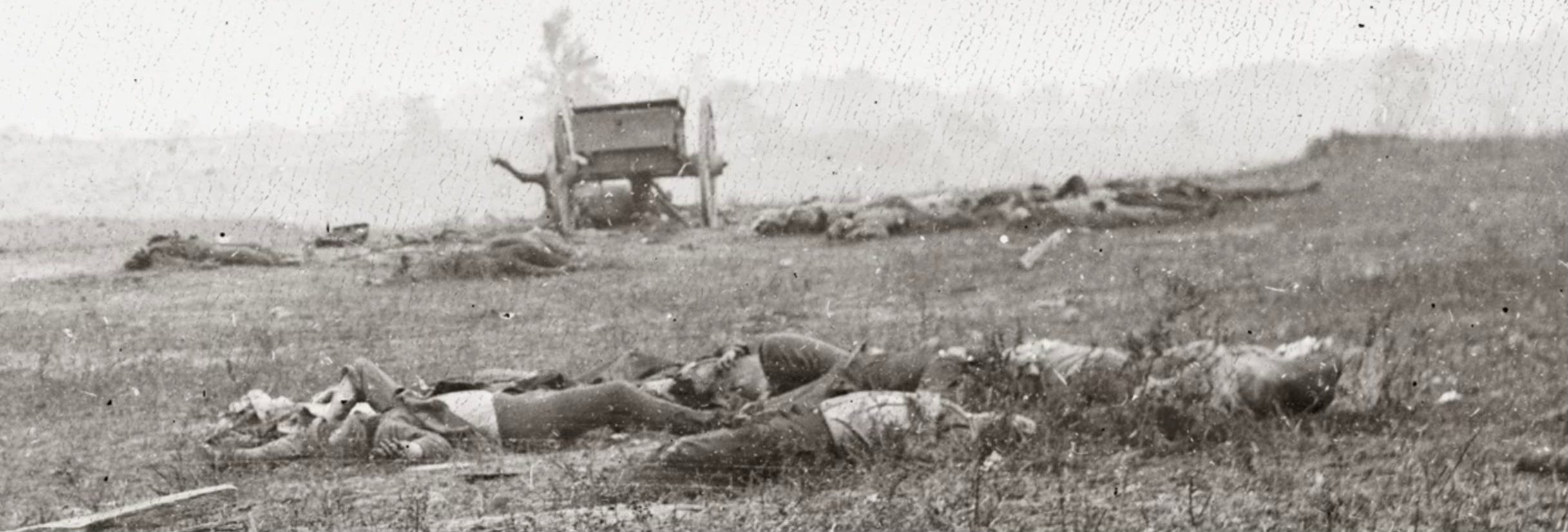
Exploring outside we approached statues and placards with a kind of slow reverence. I don’t know what it is about a battlefield site, but I wanted to walk carefully, as though the hallowed ground were still and forever wounded. We read each sign, and discussed the issues quietly. We followed a trail across the fields and through a patch of forest, and there came upon a small graveyard. It was well-tended but off the path and slightly hidden in the dappled sunlight.
Molly and I fell into a moment of thoughtful reflection, alternately bending to read a name and standing there, taking in the sober nest of stones.
After a few minutes it occurred to me to ask: “If one of these soldiers could talk to us, what would he say?”
Her reply came quicker than I had anticipated, delivered with a characteristic clarity and decisiveness: “He would ask, ‘What are we doing in Iraq?’”
At that time, the U.S. and its coalition were just beginning year three of the Iraq War (2003-2011). I can’t remember the details of the conversation that followed but it must have touched on the implications of that question, and what it would mean for the poor young man, who perished in 1862, and was now trying to make sense of his country in 2005:
What did I fight and die for? So that our brave nation would send more boys like me overseas to do battle with another poor band of young men? And for what? It’s been nearly a century and a half since all of us here gave “the last full measure of our devotion.” How long can we keep doing this? Have we learned nothing about peacemaking?
Molly is older now, with a career, a community of friends, a home and a child on the way. Sitting with her in church this past Easter Sunday, we heard Pastor Neal open the service: “Find your balance on holy ground. Breathe deeply the breath of life. Be emptied of small concerns.”
For me, I had to quiet the background noise of this new Middle East war with Iran, launched 15 years after the end of the previous war we started in the Middle East with Iraq.
At several points in the service Pastor Neal reflected on the value of community — how we all practice the hard work of love and forgiveness as we live and grow toward the light. He talked about death and resurrection, and the process of “repentance” — which comes from the Greek word meaning “to change one’s mind.” In the religious sense this is more than an academic exercise; this is the heartfelt transformation of one’s mind, attitude and actions.
It can happen. In moments hidden in dappled light. In a moment of kindness to a stranger. In a 100 year-old church. We breathe deeply the breath of life.
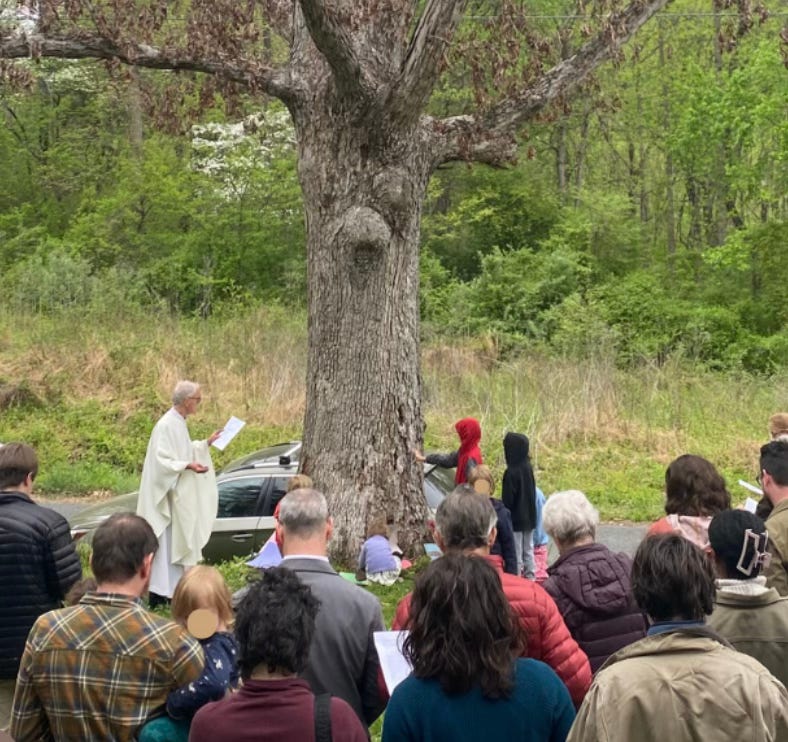
We can turn away from where we are headed. The Hebrew word teshuva (which we translate as repentance) is derived from the verb ‘to turn.”
Supply chains are global. The arms business thrives. Oil tankers drift at a sleepy pace across the oceans. The tremors of war are felt in every heart. Some days darkness seems like a growing force.
It is not.
But life is. The seed dies so that the stem might flourish toward the light (to paraphrase Pastor Neal). Then it grows to connect with a thousand other lives in its realm. And it keeps going. Life rejuvenating. Life everlasting.
Maybe peace and community are local things, residing in tangible signs of coexistence such as this intentional congress in a small church in Red Hill, Virginia, and millions of places — religious and secular — where two or three (or more) are gathered and find balance with each other.
If there is a lesson in peacemaking, maybe it is here.

Thanks for this hopeful piece, Stewart. The darkness can seem overwhelming at times and people seeming so immune to the sorrows/lessons of the past. Yet life will always prevail in small ways and communities. I loved seeing the Escher “ Dove Tessellation” again and seeing anew how the blackbirds dominated initially for me, and then the white ones emerged as the foreground! Light and dark always receding or emerging-neither gone.
Thank you for this beautiful essay, Stewart, which is both poignant and uplifting, difficult and beautiful. Molly, so perceptive always, with her succinct and pointed question. No doubt she's still asking the same question today.
"I wanted to walk carefully, as though the hallowed ground were still and forever wounded." This line captures the whole of it for me, the part our corporations and politicians are repeatedly willing to ignore.
Last night, I joined close to 60 people on a virtual call, the common thread a youth minister who served for many years at one church. We were there to celebrate the continuation of that connection, despite the miles and years between most of us. Darkness is a force that loses its strength in the face of community care, and that remains one of the most accessible forms of resistance we have!