

Thursday May 21 was the first birthday of my niece, Philippa Wicker Osborn. Happy birthday, Pippa. She was born in Massachusetts. Her middle name harks back to my maternal grandmother’s parents, Charles Sumner and Helen Adelaide Wicker. I am able to find information about the Wicker side of the family through the research of our sister Martha, also born on the cusp of Taurus and Gemini in 1950. She would be 76. (I wrote about her in a previous column, Life goes on: some notes on loss, May 22, 2025.
I spent the day thinking about Martha and pondering what I might write about in light of the latest member of the clan, Lewis Amzi Hickman, joining us some 72 hours earlier.
What happened instead was that I read various communications from Martha. The subject matter of these was so varied and interesting (to me) that I felt called to make a list — an annotated list of five artifacts that came into view for me that day:
The information about the Wicker family came from a set of essays she wrote about our (Martha’s, Pat’s and my) eight great-grandparents. Here is how the Wicker essay begins:
The Wicker line of our family arrived from Devonshire, England, in the form of William Wicker (b. 1693) around 1710. He hoped to settle in Roxbury MA, but he was a Baptist and the Puritans reportedly did not care to have such a person in their midst. An officer of some authority (I’m not clear on what sort of legal system was in place) advised him to look for opportunities elsewhere. Apparently he travelled west; his name is on the charter of the town of Leicester, MA, which he had a role in founding and where he lived out his days.
Our humble beginnings in the land of the free!
Ever the archivist, Martha would share with us artifacts from our family history at various times — old letters, drawings, photos. From an email from Martha to Pat and me:
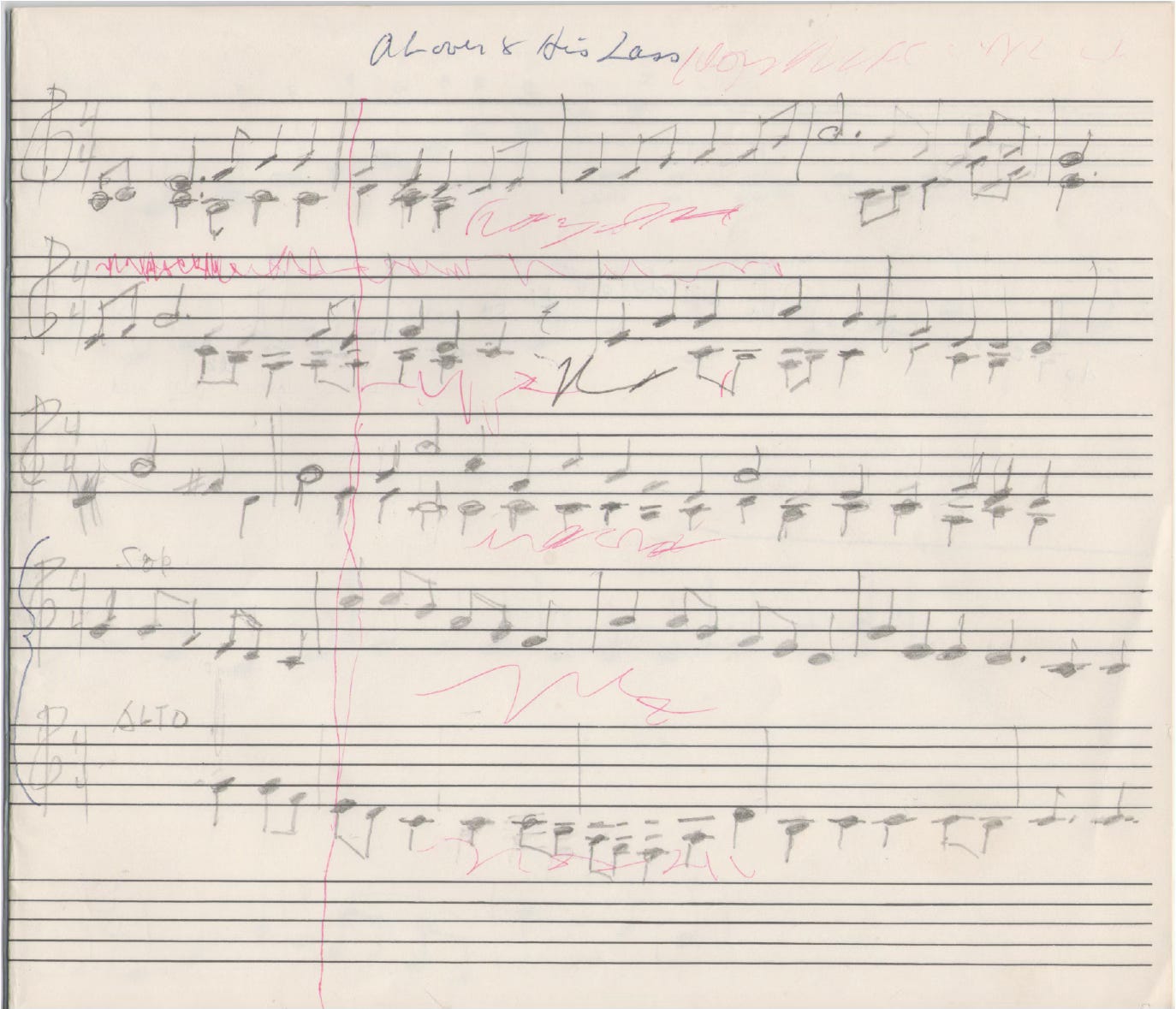
Today I was looking through a bookcase for a music album and (it was a sort of mixed collection of items on the shelf) I found an old music notebook. What should it have in it but Mom’s own notation of “It Was a Lover and His Lass” as sung by Marna and herself. Apparently I persuaded her to write it down at some point.
The song is from Shakespeare’s As You Like It. Our mom and her sister both had very fine and complementary singing voices.
I came across the playlist Martha curated entitled “Music Mom Played.” We were all familiar with the repertoire that Mom would render on the William Knabe console piano in our living room. Martha had, at her own initiative, scoured the internet to locate artists who played this or that tune in a style and tempo close to how she remembered our mom playing.
Martha selected Balazs Szokolay’s interpretation of a Bach C minor prelude, and for a prelude in C major Wilhelm’ Rubsam’s rendering came closer to how Mom played it. Andrea Bacchetti. Angela Hewitt. Janos Sebesteyen. Mary Shields. Keith Jarrett. Cyprien Katsaris — over a dozen pianists, twenty one tunes in all.
Who knows how long this took Martha, visiting digital music libraries and YouTube clips to find the “most like Mom” interpretation. I remember her exclaiming that it was a joyful process.
It appears to me that whatever the subject matter, Martha’s mind swept up all the information she could and allocated time to give new ideas some thoughtful reflection. Here is an excerpt from a piece she wrote dated Easter, 2023:
I first encountered the term “responsibilization” in the context of social work theory, as copy editor for an academic journal. So I don’t know a lot about how it may have originated or how other disciplines may use it.
But in the context in which I encountered it, in anti-sanist literature, it described a power imbalance between distressed individuals (the “mentally ill”) and authorities in medicine and government. Rather than acknowledging and addressing any structural causes of distress, authorities defined the cause to be an illness, making individuals responsible for effecting their own cure by subjecting themselves to medication, behavior modification, shock treatments, etc. In other words, although the causes of distress may have been structural, complex, and substantially not of the individual’s making, the solution was off-loaded onto the individual, protecting the system from change.
For me, this is a fabulous example of an idea that one can not un-think. This was one of a set of draft ideas she sent me. The title of another was “Capitalism as a Rouge Technology,” which deserves it own discussion.
I will just say here that Martha was never an agent of alarm, nor was she an activist in the conventional sense. I have described her thinking as “post-conventional.” There is the way most people see things — and there is Martha’s take. I have always been enriched by this part of her.
We siblings valued her wise counsel over the years, and we would tell her. She would only admit to being a good listening ear. One always felt seen, heard, and validated. Her writing is similarly engaging, her voice unpretentious, her sentences crafted with unusual care. One of the last essays she shared with me was titled “On Growing Old.” In it, she challenged the notion that old age must be characterized in a certain way, and that we should accept our decline across the board.
What other gifts lie hidden in growing old? The aging mind finds it more challenging to make decisions and nearly impossible to multitask. The aging body wearies and aches. It can be hard to stay focused and also hard to quickly shift focus. This can make it difficult to replicate the linear efficiencies that are conventionally valued, whether in the study, yard, kitchen, craft room, or elsewhere.
But I have challenged myself, and invite others, to withhold judgment and instead look for the virtues in being creatively, enjoyably unproductive: taking massive amounts of time and care to accomplish just a little; wandering from and coming back to tasks; making missteps, undoing, and redoing; starting and not finishing — even planning but never starting. Sometimes I feel in this happy, freewheeling, accepting approach a unique and unfamiliar joy, as if meeting my own dear child self on the path.
Her prose is full of surprises, such as that last phrase.
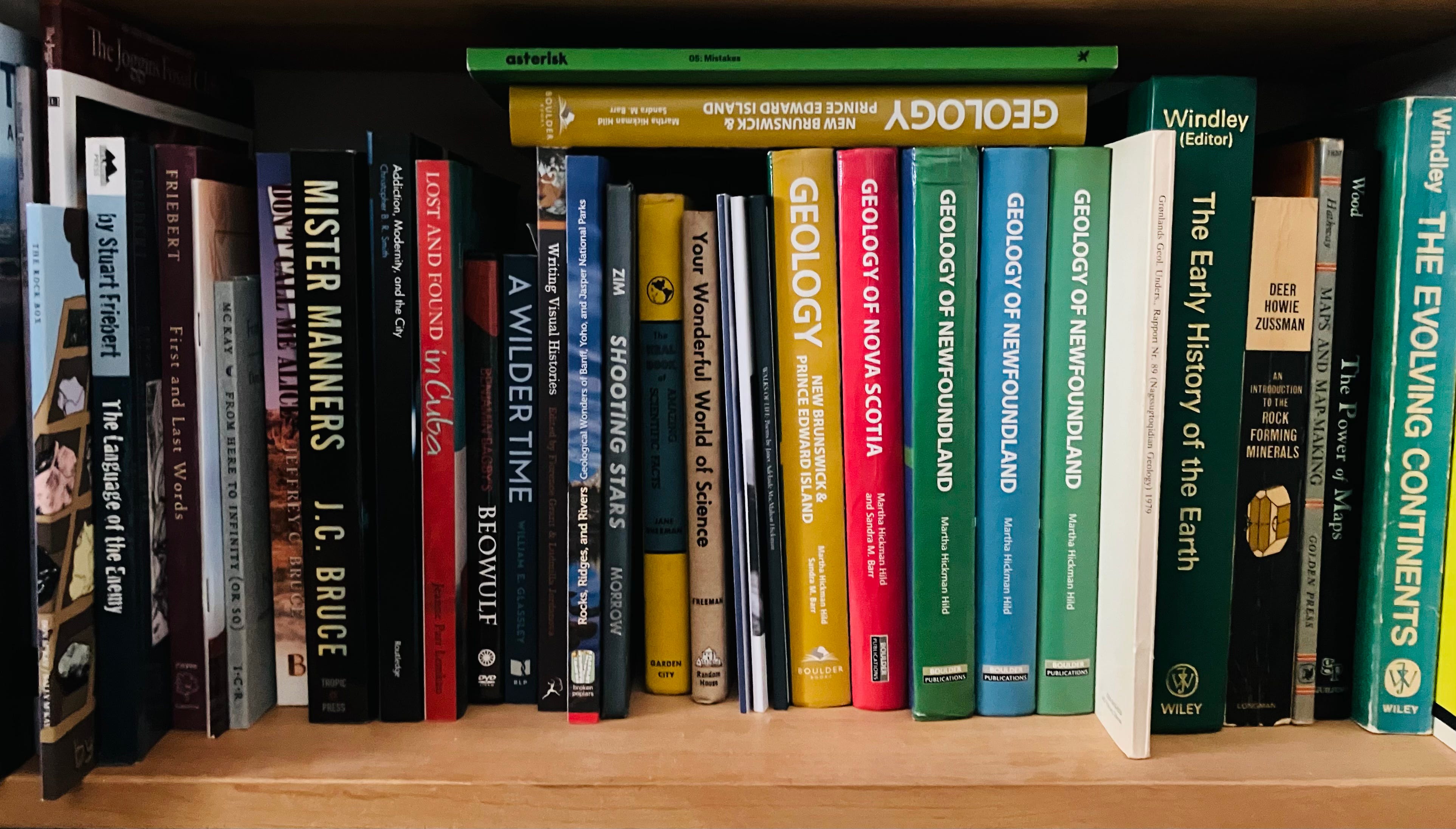
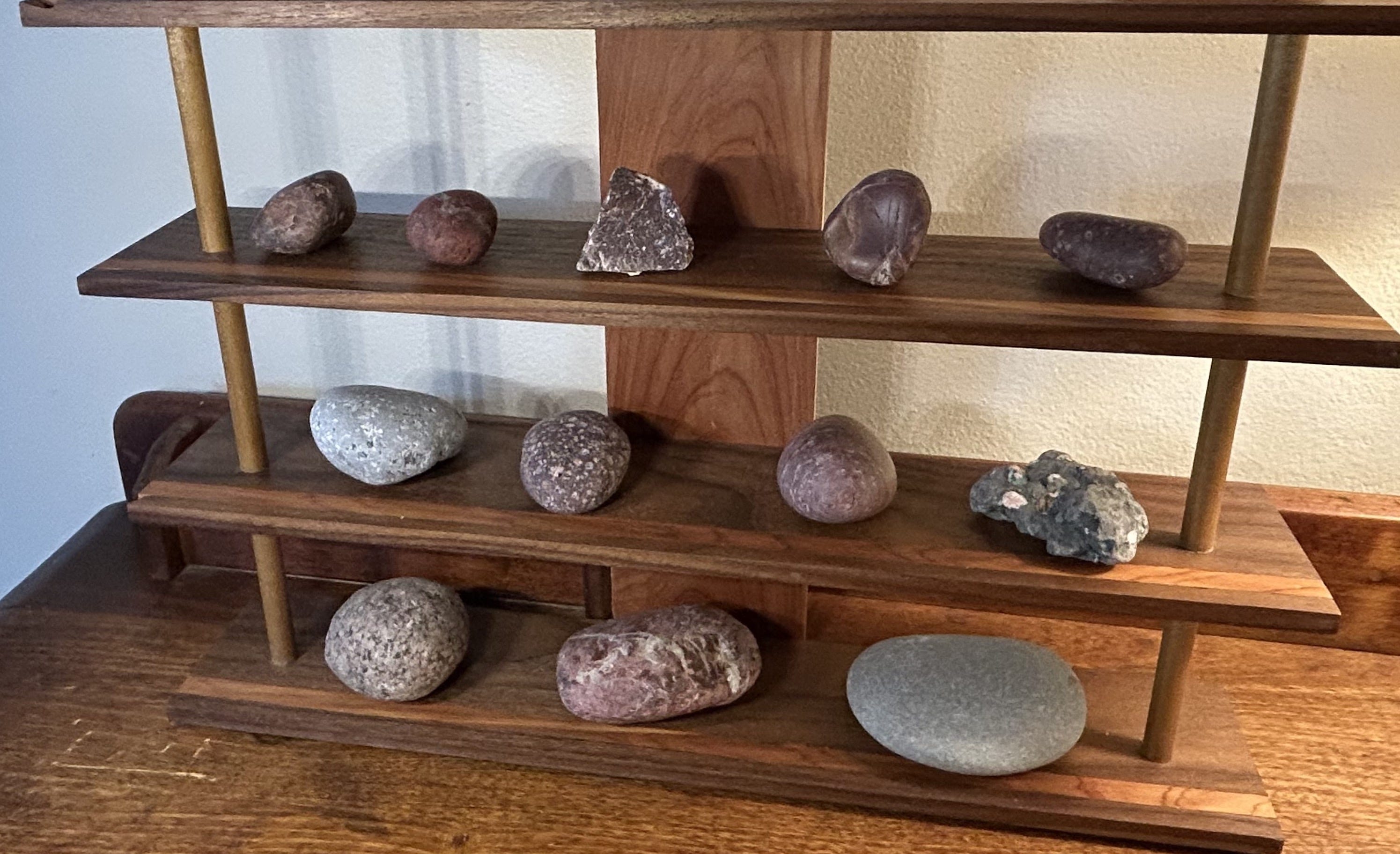
I could go on. I was looking for a particular early memory she wrote somewhere about her early interest in rocks — each with their distinctive color, texture and heft; each with their own story about where they were formed, how they moved thither, and what happened en route.
I have presented only five sample artifacts.
But know, the full list is long.
Well, I know that Memorial Day is meant to focus on the members of our armed forces who have gone on, but it seems so appropriate to bring in your sister Martha‘s reflections. Certainly as they relate to those of military service long past, and also to memory keeping in general. I remember you referencing that word “responsibilization.” It seems many capitalist systems around us have leaned into the benefits of that, and we have been well-convinced it is the way.
I can imagine how much you all are enjoying your new arrival, and I feel certain he is willing to be patient for your words about him to land on the page. Thank you, Stew…and Martha and Lewis
Wow. Really love this. On so many levels.