

Boxes of random paper documents collected over the years will grow rare and then extinct in the next decade. This is a forecast I just made based on my need for a good hook sentence. But just in case I am right, I recently went through a box of papers of my own.
In it I found a typewritten list. At the top it read:
THINGS TO PONDER — “An Eschatological Laundry List: A Partial Register of the 927 (or was it 928?) Eternal Truths” by Sheldon Kopp from the book If You Meet Buddha on the Road, Kill Him.1 A Bantam Book, 1972.
It’s presented as a tongue-in-cheek (or is it??) list of Zen-like (or are they??) statements such as:
This is it!
There is no way of getting all you want.
You can only keep what you give away.
It is a random universe to which we bring meaning.
All evil is potential vitality in need of transformation.
You get the idea.
You can find the full list easily with a google search. There are 43 items, and they comprise the closing pages of Kopp’s book.
It is not a great list. It might not even be a good one. Certainly not an eternal one. But in taking this list in my hands, I was transported back to the typewriter days of my late teens/early 20s. This was a photocopy of the original—and the two-page list was scotch-taped together. I had circled some of the items in red pen, probably fifty years ago, at the beginning of my epistemological journey.
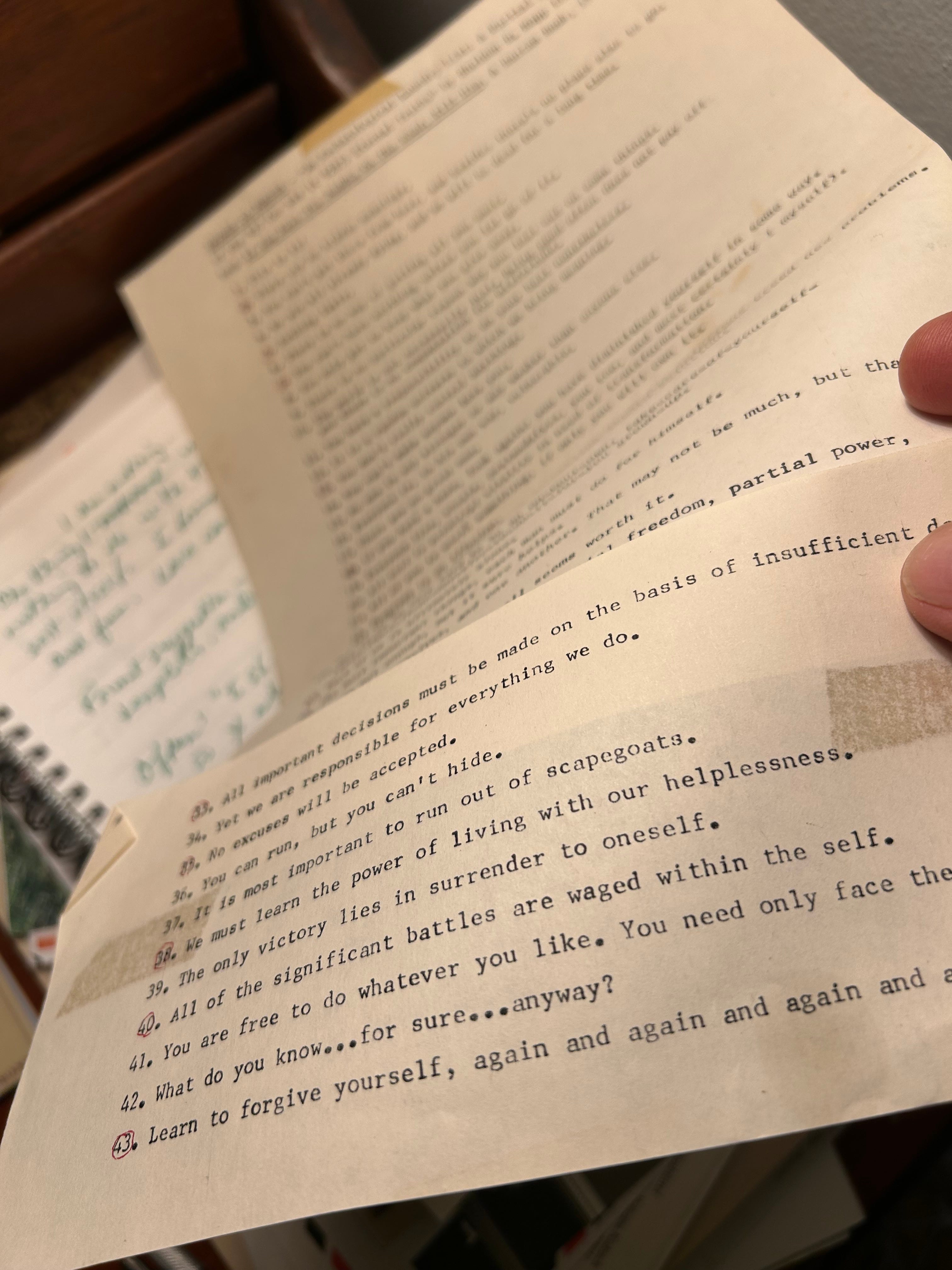
Among this list of faux-Zen aphorisms and candidates for quotes on dorm room posters, here are five that jumped out at me then, and now:
23 Evil can be displaced but never eradicated, as all solutions breed new problems.
24 Yet it is necessary to keep on struggling toward solution.
33 All important decisions must be made on the basis of insufficient data.
40 All of the significant battles are waged within the self.
43 Learn to forgive yourself, again and again and again and again…
When I read #23 and #24, I saw the frame as society and the larger world, in contrast with #40 and #43, where the focus is the individual. The middle item, #33, seems to apply to the largest enterprise or the individual human, and everything in between.2
I am writing this on the 25th anniversary of 9/11. As an American, it is easy for me to assert that evil was inflicted upon us that day. And that the subsequent “Global War on Terror” in all its manifestations is an attempt to eradicate that particular source of evil.
However, according to #23, evil is only displaced, and our solution has bred some new problems. These problems range from the trivial — the inconvenience of taking off our shoes before boarding a plane — to the truly incomprehensible — the trillions of dollars spent or obligated to conduct our wars since 2001, the lost opportunities those dollars represent, and the nearly one million lives lost in Afghanistan, Pakistan, Iraq, Syria, and Yemen through 2021, if you include military, contractors, journalists, humanitarian workers, opposition fighters, and civilians — who by some estimates represent 40% of the nearly one million. (See Brown University’s Cost of War Project for one set of data. There are others.)
We can debate sources and what counts as the human toll of war, but I have to say — not to disparage our mighty military — the pestilent fog of war metes out more than its share of evil. The global war on terror generates terror, if you stop and think about it.
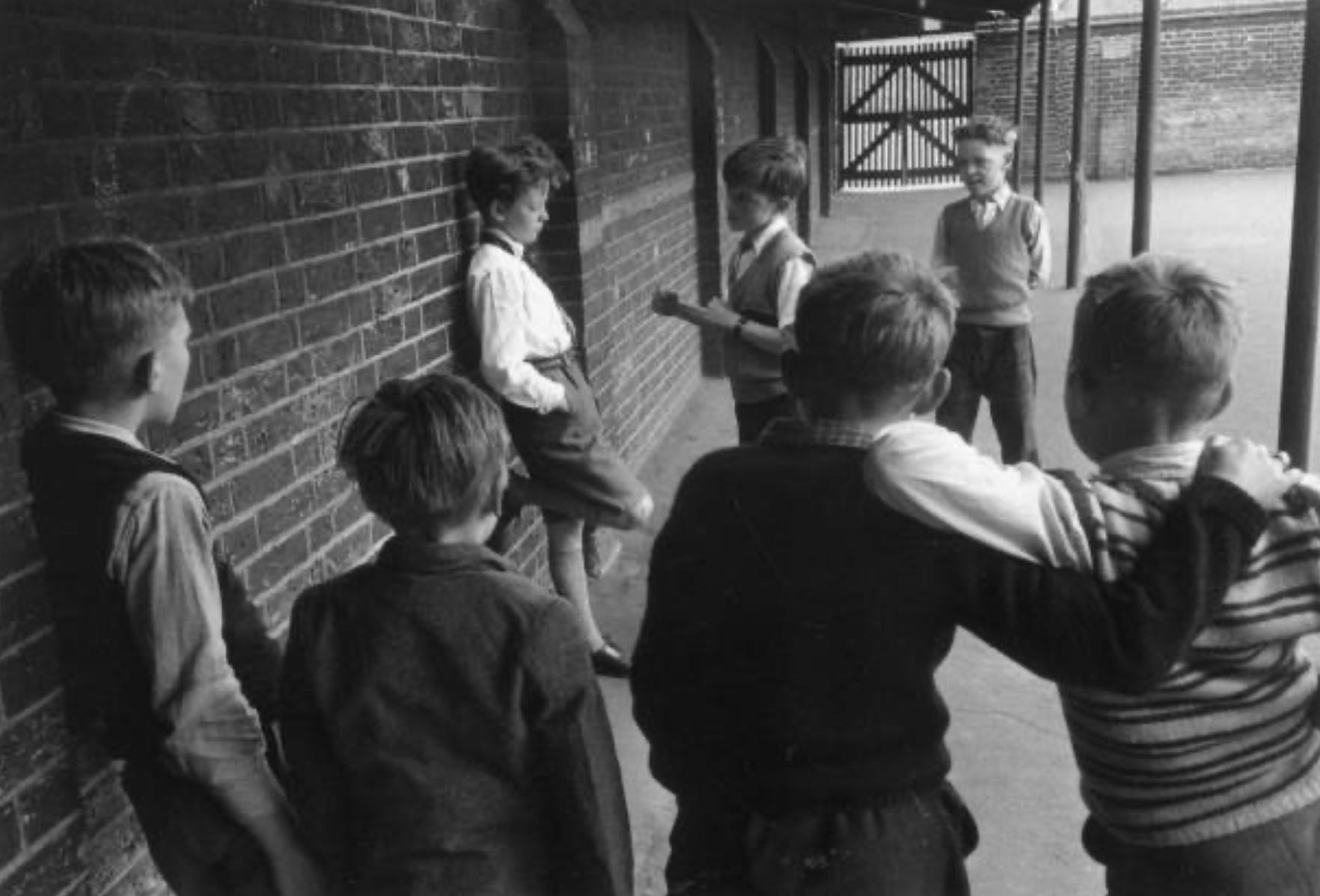
War begets war. Seems so obvious to say this. So much of history is the story of this “he hit me first!” life lesson. The playground of life.
Which brings us to Statement #40 “All of the significant battles are waged within the self.” At first, this feels like a stretch. Tell this to soldiers who fought, say, the Battle of Midway (1942). They would rightfully claim this battle, a turning point for our side in the Pacific, as very significant. Ditto the Battles of Vienna (1683) and Hastings (1066), both critical in shaping the West European part of the world.
Aphorisms often ring of hyperbole, which accounts for their endurance. Even in my late teens, I would have assumed these “battles” were metaphorical. But how did it make my red-circled short list? With only a couple of decades on earth under my belt, I am not sure I had much profound conflict in my young soul. Since then, certainly, but not at that time.
I have thought about this a lot over the years. I have read Marshall Rosenberg (non-violent communication), Jiddu Krishnamurti (external conflict is the outward projection of unresolved psychological conflict within the individual), Carl Jung (what we don’t confront in ourselves gets projected onto others), various Stoics (disturbance doesn’t come from external events but from our judgments about them), Thich Nhat Hanh (inner turmoil is the seed of interpersonal and social conflict), Thomas Merton (the “false self” — ego, vanity, the need to be right — is what generates conflict with others) and Rumi (outward conflict results from inner unrest).
The world stage gives us such clear examples of war-makers. They are as easy to spot as bullies on the playground. I can not begin to imagine the battles left unwaged in their hearts — their debilitating inner demons, unexamined shadows, self-doubt, abject fear of humiliation. They seem to me helplessly pulled apart by the horses of fear and power. Their wars reap a grim harvest of human misery, wasted resources, and stolen lives.
War might very well be the most terrible manifestation of the unresolved turmoil within a few emotionally tortured men.

Our nation does not have a good track record of reconciliation or apology. Maybe it falls to us, the people, to say we are sorry to the world for our trespasses.
And yet… it is necessary to keep struggling for solutions. It is necessary to keep singing about the hope of peace. It is necessary, I think, to identify and deal with those unwaged battles in ourselves. And keep at it.
Love yourself. Love your neighbor.3 If your enemy is hungry, feed him.4 Hatred does not cease by hatred, but only by love; this is the eternal law.5 Repay injury with virtue.6 Darkness cannot drive out darkness; only light can do that.7
These are old, recurring human realizations.
Worth trying to scale out, as best we can.
The title is a bit cringey and deserves a footnote. The statement is from a 9th century Chan master Linji Yixuan. It’s a warning against attachment to external authority, even sacred authority, as a substitute for direct realization. To paraphrase Alan Watts, don’t mistake the pointer for the thing it’s pointing at, even when the pointer is the Buddha.
BTW, the origin of this statement might have come from a 1939 speech by Judge Learned Hand (1872 - 1961) in which he said “...life is made up of a series of judgments on insufficient data, and if we waited to run down all our doubts, it would flow past us.” I am presuming the “it” to which he refers is life itself. Beautifully crafted prose (plus, you gotta love his name).
Mark 12:31
Proverbs 25:21
The Dhammapada (a record of Buddha’s teachings) verse 5
Tao Te Ching, chapter 5
Martin Luther King, Jr., in Strength to Love (1963)
Lovely post, Stewart.