

The last time I flew internationally my destination was Bangkok, in November 2018. The company I worked for was piloting a course for manager-level supervisors at USAID.
I am not sure I have a “take away” from that journey, except perhaps the evanescence of life. All these things — action plans from workshops, memories of camaraderie, even whole institutions — once clear and vital, can drift from sight.
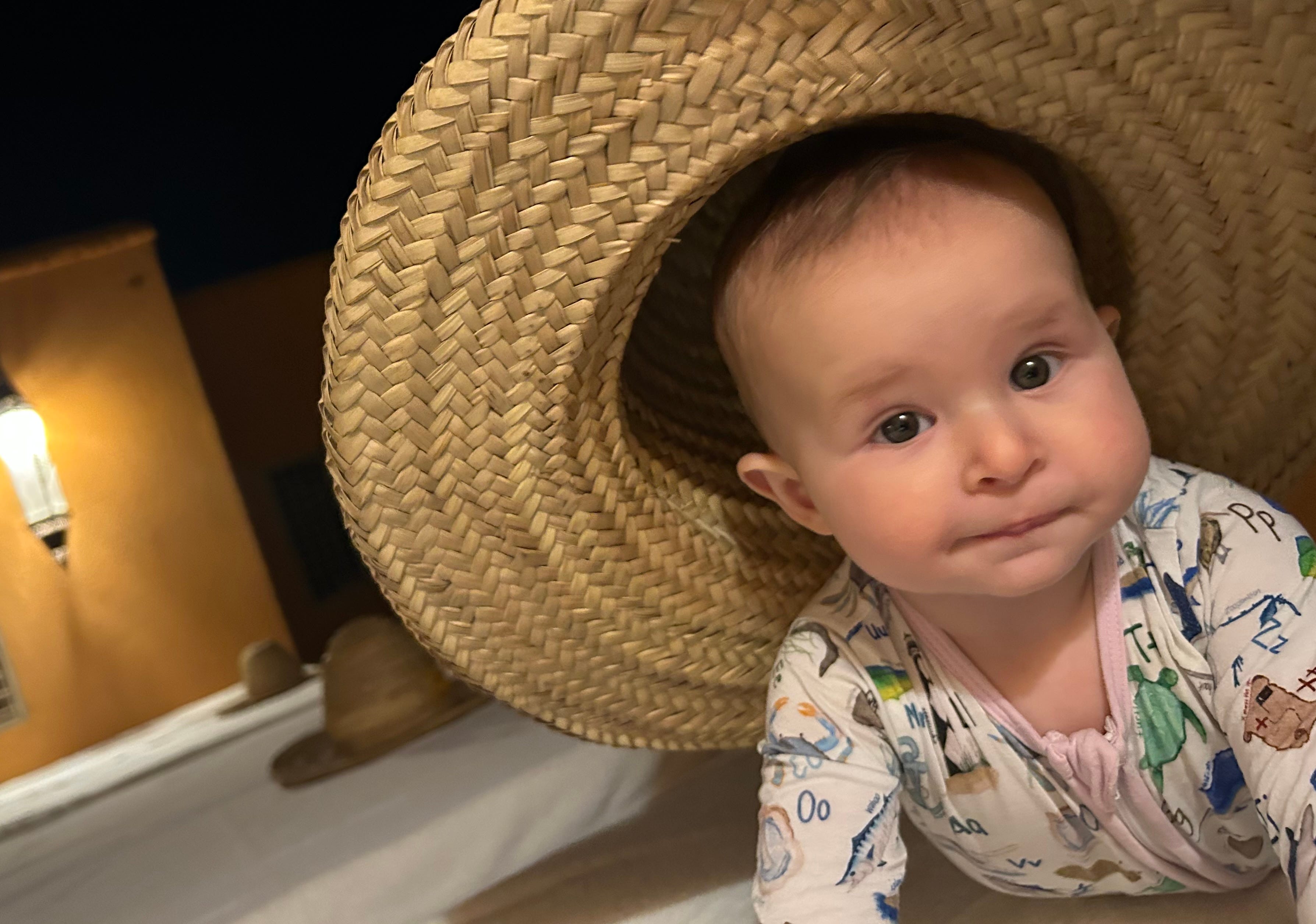
This was my first entirely leisure foreign venture with family in fourteen years. When our daughter Molly was planning for her week-long company retreat in the old city of Marrakech, she asked if we would consider accompanying her and Lewis (now nearly 6 months old). We could plan some family time prior to her work days.
We had never been to Morocco and loved the idea, so we signed up. We were all pretty experienced travelers by now, our passports were all up to date, so it would be easy to carve out a week.
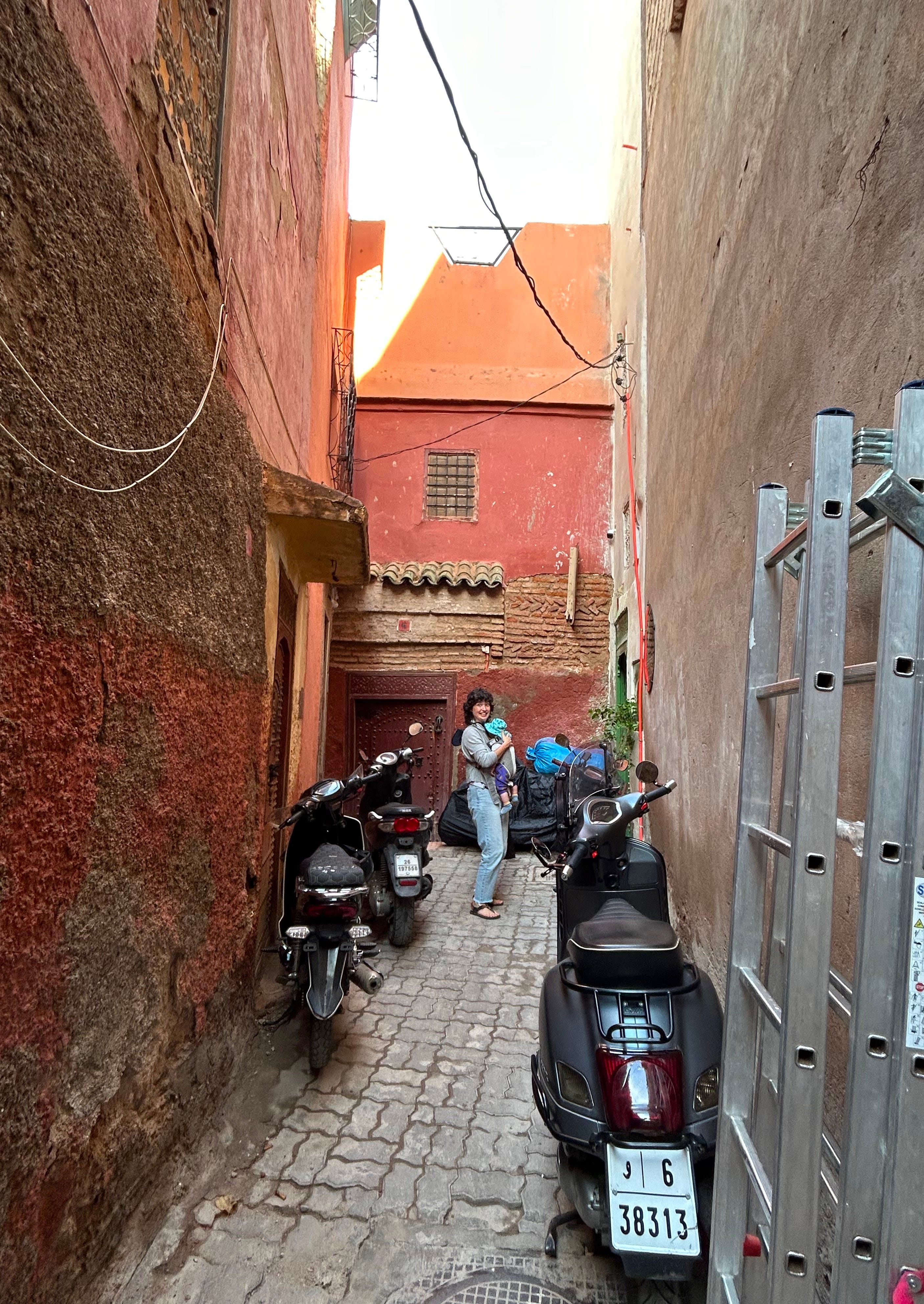
I should note here that several kinesthetic changes have occurred in the years since my late fifties. I am slower to sit and to rise, have occasional balance issues, mild arthritis in both knees and slightly less upper body strength.
Consider this tai-chi-like maneuver taking place in a narrow Medieval passageway: discuss with daughter the tip for our guide; extract said tip from wallet while pivoting left to say farewell to guide; press money into his palm and shake his hand; pivot right being mindful of my turning radius (wearing a small back pack); check periphery for passing tourists and mopeds1; during slow step, dodge any of a number of stray cats underfoot.2
This land just south of the Rock of Gibraltar has been home to and/or controlled by the Amazighs (Berbers), Phoenicians, Carthaginians, Romans, Vandals, Byzantines, Visigoths, Arab-Muslims, Portuguese, Spanish, and French. Never the Ottomans.3
The citizenry seem proud of their diverse and complex history. Morocco is unusually progressive for a kingdom in the Arab world. More than one guide pointed out the three spheres atop many of the minarets, signifying the three Abrahamic religions which even today are all represented in Morocco: Islam, Judaism, and Christianity. Perhaps these three spheres offer a reminder that what unites us is far greater than what divides us—a truth too easily lost amid the conflicts and divisions that dominate our world today.
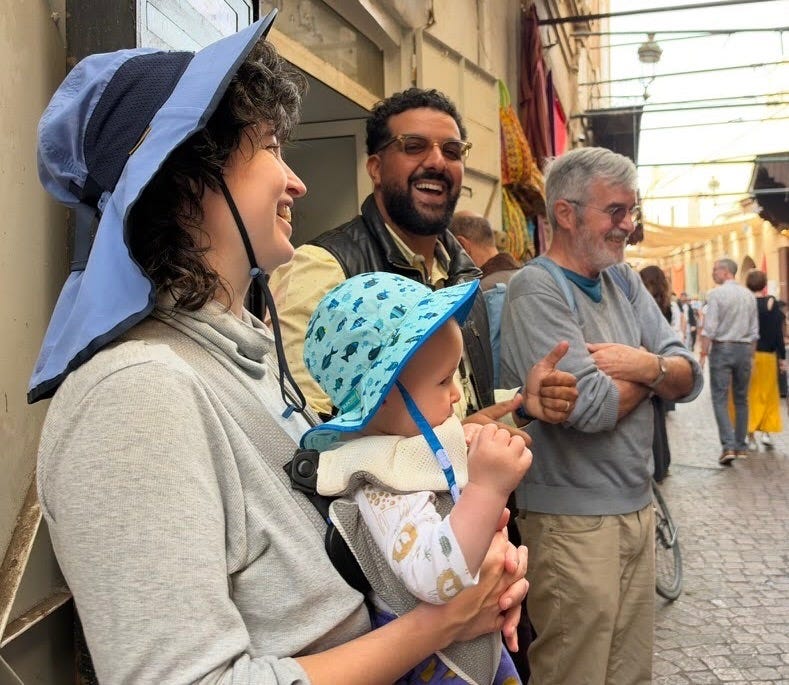
We were having a roof-top lunch with our guide, Mostafa. The flat skyline of Marrakech surrounded our view. He put it this way:
You take a piece of blank paper, and you put a single dot in the middle. You ask people what they see. They will say, there is a dot. They focus on the object, the thing that is different. They don’t say, there is mostly white. People focus on our differences and miss seeing the huge area that we have in common as members of humanity.
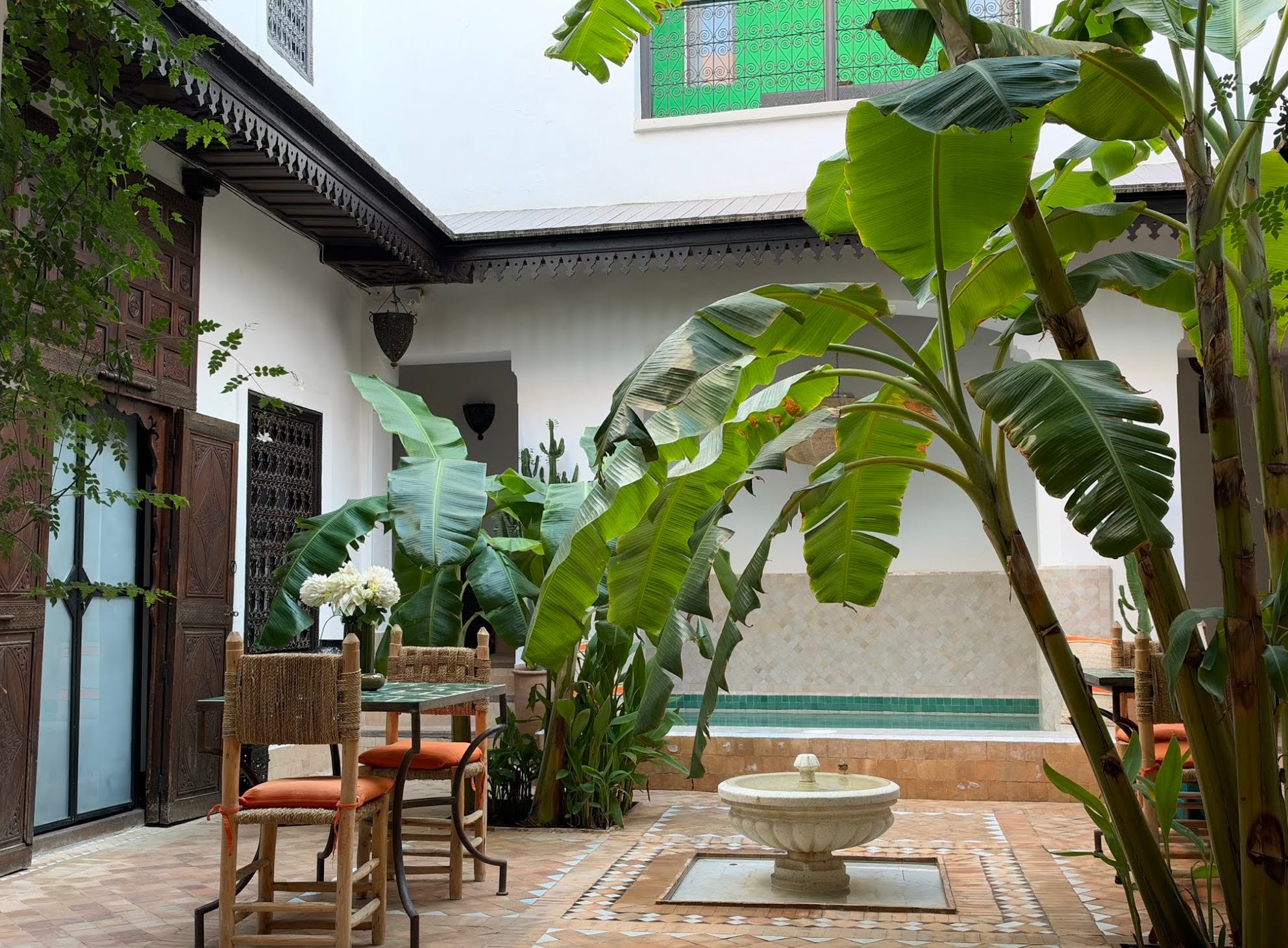
Mostafa showed us the landmarks of Marrakech, in particular the old walled city (medina) of Marrakech — much of which was built in the 11th century. It is now a UNESCO World Heritage Site. We stayed in a riad, or guest house. The word riad comes from the Arabic word for garden. This traditional house is built around an interior courtyard. You access the house from the alley through a modest door. From the street you would never guess the quality of the sky-lit living space on the other side. The quiet and calm beauty faces inward.
Multiple generations of a family could live under one roof, Mostafa explained. Elders were taken care of by their children and grandchildren. As many as 30 people could live together in one riad.
Mostafa was our teacher and interpreter of this remarkable country and its culture. He shared with us the spiritual and communal ideal of life within the narrow complex of these walled homes.
It is said that when you live in a riad, you take care of the seven neighbors on your left and the seven neighbors on your right. This is to say, we are social beings. We are meant to take care of each other.
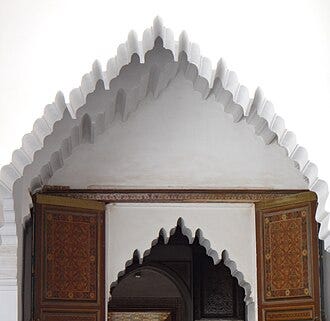
We visited the Bahia Palace, built in the 19th century. We walked through gateways into fragrant gardens and bright courtyards with elaborate fountains and tiled walls. Along our tour Mostafa talked about the five pillars of Islam, the fifth of which is the pilgrimage to Mecca, or Hajj. He brought our attention to a tile motif, a wave-pattern made by alternating shapes of blue and white.

Mostafa put it this way:
After I go on a Hajj, my name would be Hajj Mostafa. You come back transformed. It’s a clean slate so to speak. But more is expected of you — more good deeds, and fewer mistakes!
Is this adventure transforming me? I asked myself as I walked under an elaborate Lambrequin arch and stepped down into a shaded portico. My culture has no Hajj counterpart. I think about the thresholds that were available to me. You might recognize them, or have some of your own. When I got my drivers license? How about my Confirmation (Protestant, around age 14)? Graduation from High School? College? Coming back from a 5-day silent retreat?
Struggling here. I’m not seeing anything remotely Hajj-like.
The most I can hope for, I am coming to realize, is to be alert to small moments.
I am holding Lewis, looking out together over a rampart. He is seeing the Atlantic Ocean for the first time. I am watching him, curious to know the shape of his thoughts. What will he retain?
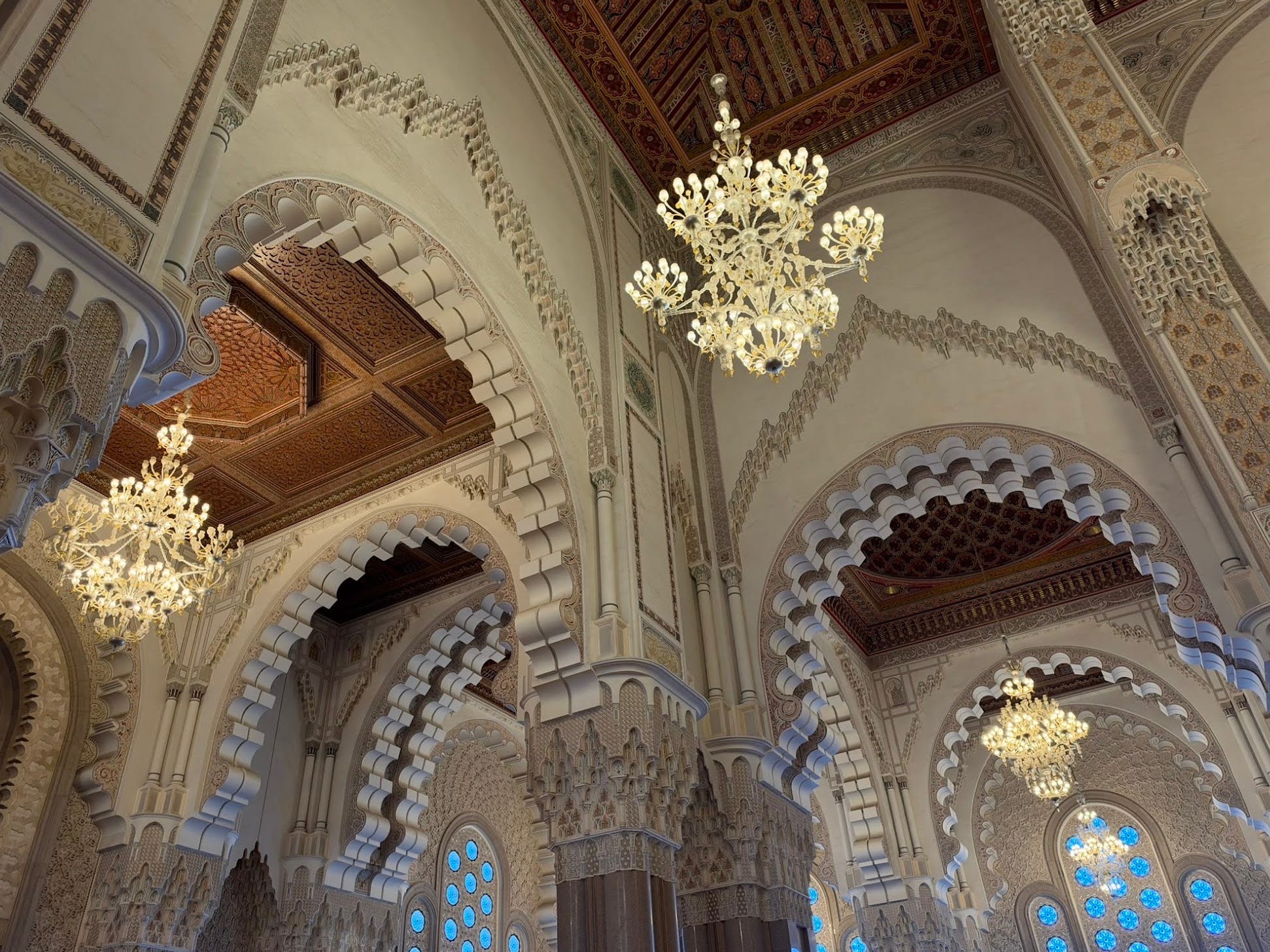
I am standing in the King Hassan II mosque. The ceiling is glorious. The space is enormous, a marble forest, a unity of spirit. There is so much more than the eye can seize. What will I remember?
We are listening to the evening prayer, drifting into the room from a dozen minarets within earshot. Though the words are in Arabic and the text is from the Koran, some ideas are universal.
Take a moment to think about the unity of life.
Think about all we are grateful for.
Come to prayer. Come to flourish!
There is one God and he is in all things.
Everywhere you look.
And isn’t that amazing?
Our guide for that day, Mostafa, cautioned us about watching out for mopeds in the narrow streets of the medina (old city). “‘Balak!’ means ‘watch out’ in Arabic. If you hear ‘Balak!’, get out of the way.” Always quick with a joke, Mostafa added that the university in Marrakech did a study and found that “when you hear ‘balak!’ a second time, it is too late.”
This mindful movement is known as Pay man/Swing pack/Step with tiny lions.
One artifact related to this: Minarets in the world once dominated by Ottoman culture are round, cylinder-shaped. Moroccan minarets are square as they have been for millennia.
I loved reading your travel reflections. Sounds like you all had a great trip!