

Some people never give up their idealism. I say this as a man born in the middle of last century. I lived through the counter-cultural movement of the 1960s, albeit at the tail end of it. Our generation was going to change the world. Remember?
I guess I remember the feeling. But all I know is once I graduated from college, my preoccupation was getting and keeping a paying job. Whatever idealism I had had through those formative years fell away, out of necessity.
But for some people, like Wendell Berry, their life’s journey follows resolutely the path of their truest convictions. He died last week, at age 92, at the farm where he and his family had been working for forty years. He was a writer, poet, teacher, and activist/advocate for sustainable farming. If you are not familiar with him, here is his Wikipedia entry and here is an obituary (without a paywall).
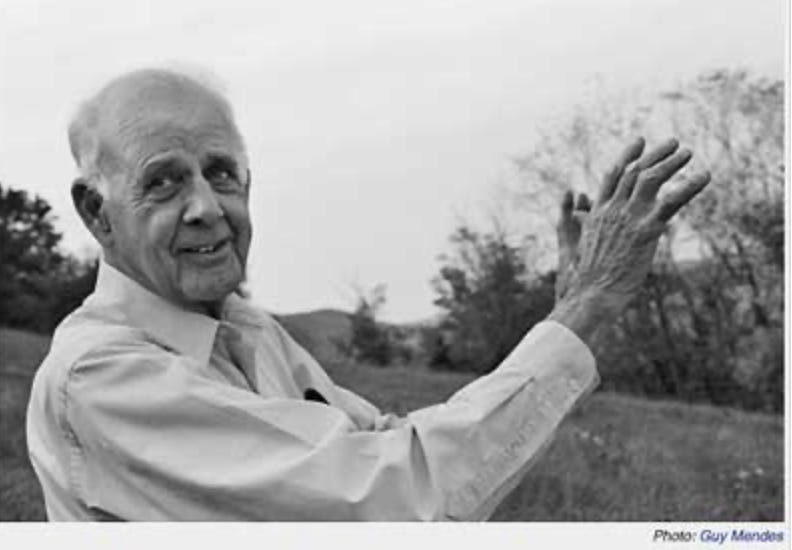
Many of us in our youth sang about how “we got to get ourselves back to the garden”until time and societal expectations urged us to move along. But in Berry’s case, he circled back early in his career. After a few years of teaching and living in New York, Berry “confronted in himself a deep need to return to his roots — specifically to an old two-room cabin on the Kentucky River where his ancestors had lived since 1803.”1
He championed small farms and local foods long before these movements gained cultural traction. He grieved the loss of America’s agrarian past and rallied against a source of income inequality borne of American corporatism. The New York Times obituary cites an interview with Sierra magazine in 1990 — 36 years ago:
The national economy, that is really run for the benefit of a very few people, is preying upon and slowly destroying local communities everywhere. Everything we produce in rural America makes more money for other people than it does for those who produce it.
He watched this phenomenon over the decades: corporatism infecting every sector of our nation, extracting from the land what it needed to keep its inexorable machine rolling. Nevertheless, Berry maintained his role as activist and spokesperson for the benefits of proper land stewardship, and he kept finding solace in the experience of nature.
And so I go into the woods. As I go in under the trees, dependably, almost at once, and by nothing I do, things fall into place. I enter an order that does not exist outside, in the human spaces. I feel my life take its place among the lives — the trees, the annual plants, the animals and birds, the living of all these and the dead — that go and have gone to make the life on earth.2
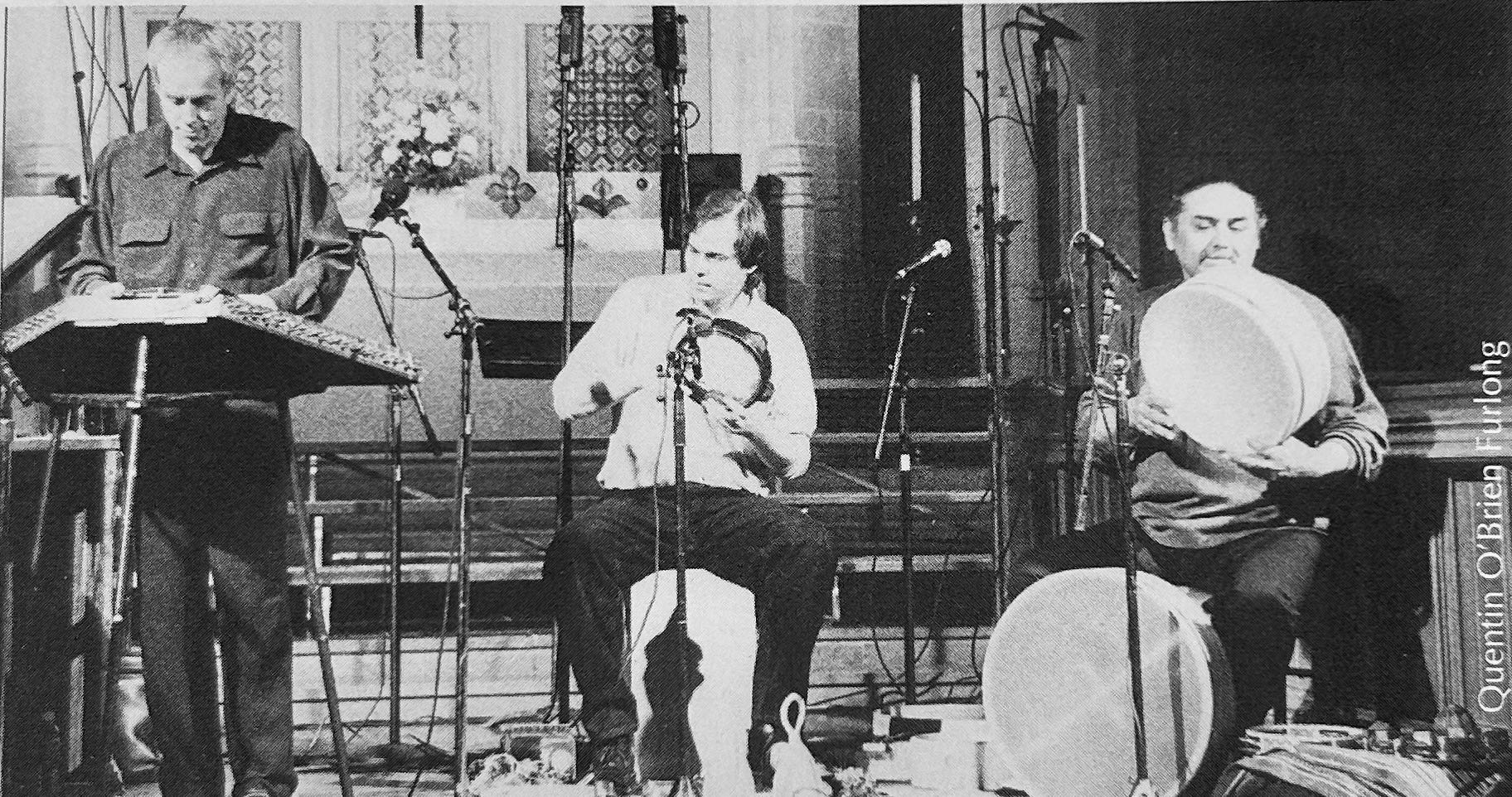
I knew some of Berry’s poetry from anthologies I had come across in my college studies, but developed a deeper love and appreciation for his work when I had the opportunity to sing some of it. Composer and musician Malcolm Dalglish set a number of Wendell Berry’s poems to song. I referenced the 2010 performance at Strathmore Music Center for the 40th anniversary of Earth Day in a previous post entitled New Life, posted April 25, 2025.
About Malcolm Dalglish’s musical settings of his poems, Berry had this to say:
Words and music, I always assume, began together. In poetry, words remember song. In my own work, for a long time, the words have seemed to be in search of their native or appropriate music.
He goes on to say that Malcolm’s music “gives the poems a completeness that I desired but did not imagine.”
Berry was prophetic, but his words did not seem to carry the “doom and gloom” of a jeremiad (n. /jĕr″ə-mī′əd/ literary work or speech expressing a bitter lament or a righteous prophecy of doom” — to save you having to look it up as I did). He acknowledged that humankind created the ecological fix we are in; but he also held onto the hope that humankind could repair the damage through deliberate, local stewardship.
There is a brightness there that I admire. It reminds me of my daughter Molly’s Lenten Reflection she composed and shared with her church congregation two years ago. In it she shares this anecdote:
I saw a comic the other day where two people are gardening and one person says “Aren’t you worried what 2024 will bring? Everything is so crazy these days,” and the woman says, “I think it will bring flowers.” The man says, “Oh really? Why?”
“Because I’m planting flowers.”
You can feel a similar light of hope in this next poem — a sense that we are can pass along some kind of wisdom to the next generation:
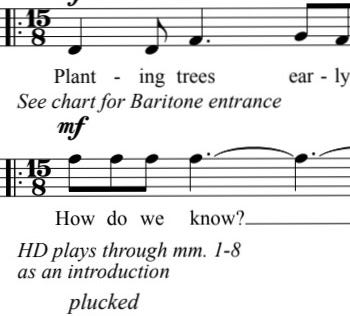
For the Future, by Wendell Berry
Planting trees early in spring,
we make a place for birds to sing
in time to come. How do we know?
They are singing here now.
There is no other guarantee
that singing will ever be.
Dalglish composed a beautiful choral round with these words, with four groups of soprano and alto singers coming in one after another and blending their voices, underpinned by a lower baritone group, with hammer dulcimer and percussion setting the beat. And for you choral music enthusiasts, the piece is set in 15/8 time. The effect mimics birdsong, I think.
Have a listen below. Gisele Becker conducts the Carpe Diem community choir in April 2010 at Strathmore in celebration of the 40th anniversary of Earth Day:
The first Carpe Diem choral arts residency culminated in a public performance on April 15, 2003. It was entitled A Ceremony of Song for Folk Choir, Hammer Dulcimer, Percussion and Dance. It opened with a bagpipe processional (performed by Axie Blundon, age 16) of the Scottish/Irish lament “Lochaber No more” which is used as the musical setting for Berry’s tribute to his own father.
In the spirit of endings and beginnings, I close my humble tribute to a great man with “Epitaph.” Below is the recording of Malcolm Dalglish and The Ooolites with bagpipe introduction by Jennifer Armstrong from the 1999 CD “Pleasure.”
Epitaph by Wendell Berry
Having lived long in time,
he lives now in timelessness
without sorrow, made perfect
by our never finished love,
by our compassion and forgiveness,
and by his happiness in receiving
these gifts that we give. Here in time
we are added to one another forever.
From New York Times obituary by Robert D. McFadden, August 31, 2026
From Washington Post obituary by Hillel Italie, Associated Press, September 2, 2026.
Thank you Stew. This is a beautiful tribute to a deeply inspirational man and I was moved and honored to hear my piping at the end. 🎵
Oh, Stew. Tears of remembering here. Thank your for this beautiful tribute. I, too, chose For the Future as a way of acknowledging the loss of Wendell Berry in a recent piece. "Added to one another forever."
Thank you so much for linking those recordings. The Eastern Shore version of that show will always hold special memories for me and my family.