

This time of year the raw political discourse provides way too many examples of the worst of human rhetoric. Think how political figures fling epithets back and forth, the adult equivalent of the elementary school come-back “I know you are but what am I?”And consider commonplace profanity and vulgarity have become.1
“Do you kiss your children goodnight with that mouth?” I want to ask. And I would add: “You didn’t used to be like this,” because mostly people don’t start out being horrible to each other.
I thought it would be helpful at this point to review group norms. These are typically presented as lists of behaviors that a team, an organization or a community has decided would be helpful in the conduct of business.
In my consulting work, group norms were often established before meetings or workshops in which people would be working together to analyze problems, explore options and make decisions. Prior to the discussion, I might ask a question along the lines of What behaviors would you like to characterize our discussion today? or What guidance would help us all get the most out of today’s session?
Here is a representative list from a department retreat I facilitated in 2017:
Be considerate
Civility in tone and intensity
Be constructive
Allow all to be heard
Give attention
Manage technology
Everybody contribute
Have fun
Be open-minded
Be respectful
Having facilitated meetings in many countries over the decades, I have a collection of lists of group norms. I am stuck by how similar they are across cultures and nationalities.
Establishing norms that a group can agree to is particularly helpful in conversations where there is unresolved conflict, strong feelings and the stakes are high.
I served as a panelist for the Maryland State Arts Council, and we would review and recommit to this short list of agreed norms at the beginning of each session:
Balance speaking and listening: Encourages a dynamic of mutual respect rather than dominating conversations.
Use “I” statements: Keeps the dialogue constructive and grounded in personal perspective.
Apply “Yes, and…”: Build upon, rather than shut down, coworkers’ ideas.
Approach with curiosity: Promotes inquiry and a belief that everyone’s presence holds value.
Similar lists have been developed for whole organizations, as guidelines for how we want to treat our customers, or partners, or each other. Sometimes part of a description of “organizational culture,” these lists are not designed to catch and punish offenders. They serve as guide rails, if you will, targets for how a group wants to comport itself.
I like the idea that groups can aspire to “work hard and be nice.” Nothing on the list would surprise anyone: the value of any item on the list seems self-evident. Of course I want to be respectful. So, why write it down and keep it posted for all to see?
Because it is often hard work and we need reminders. Especially, as I have noted above, when people feel strongly about an issue and something they care about is at stake.
And, because at some point in our upbringing, even into our adulthood, caveats are implicitly or explicitly added. Never back down. Cover your backside. Ends justify means.
But people don’t start out with defensive behaviors, coarse language or obsessive self-aggrandizement. People — most of us — start out with guidelines and examples designed to bring out best in us.
I would invite you to watch for the ways in which this concept is introduced at an early age.
At the church I attend, there is a Children’s Church program run by a bright and engaging young woman, Kate. The young children comprise a range of ages. Kate helped the group to come up with a set of norms. These are posted in the area where the children learn and play together.
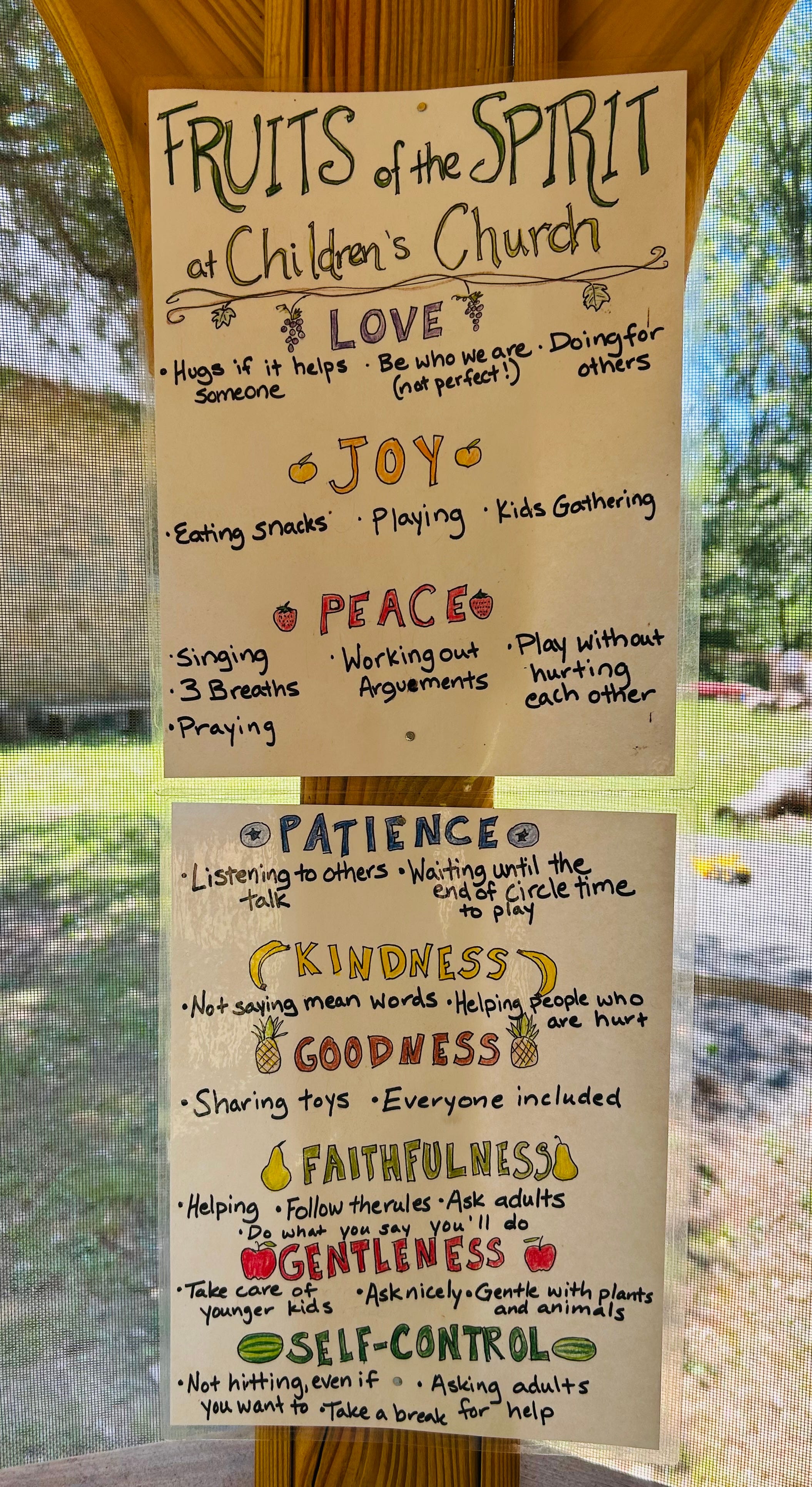
There are nine headings (Love, Joy, Peace and so on) and each heading is centered on the poster. Under each heading are a few examples.
Here is the text:
LOVE
Hug if it helps someone. Be who you are (not perfect!). Doing for others.JOY
Eating snacks. Playing. Kids gathering.PEACE
Singing. 3 breaths. Praying. Working out arguments.
Playing without hurting each other.PATIENCE
Listening to others talk . Waiting until the end of cycle time to play.KINDNESS
Not saying mean words. Helping people who are hurt.GOODNESS
Sharing toys. Everyone included.FAITHFULNESS
Helping. Following the rules. Do what you say you’ll do.GENTLENESS
Take care of younger kids. Ask nicely. Gentle with plants and animals.SELF-CONTROL
No hitting, even if you want to. Take a break. Asking adults for help.
This is a beautiful list, not just for conduct on Sunday mornings, and not just when you are a child. There is nothing here to argue with. We take these truths to be self-evident. My personal favorites: No hitting, even if you want to; Be who you are (not perfect!) Each honestly acknowledges the human condition.
If we go back even further, we can find behaviors associated with Peace, with Kindness, with Gentleness. The adult world models these for the newly born, before language, before fine motor skills, before self-consciousness. I think about the fruits of the spirit and all the ways that grandson Lewis has experienced them in these first five months of life. He certainly has the Joy part down.

Getting out of her car in front of our house, daughter Molly overheard a son, maybe a 5- year-old, ask a question to his mom as they walked by. He pronounced the word “true” twoo.
Is it true that we have to be nice to our neighbors, even the new ones?
This is a beautiful example of early curiosity about Gentleness and Kindness. And Love. I take it as a good sign.
A blessed few of us are able to consistently follow these kinds of examples and guidelines for gracious communication and kind action.
Most of us take out our mental list now and then, dust it off and recommit to being better.
Not perfect! But better.

There is an old quote that comes to mind, something along the lines of “Profanity is the effort of a weak mind to express itself forcefully” which is, by the way, a fabulous zinger. Unfortunately if you use the phrase to admonish someone, you will be told to f— off.