

It is difficult for me to focus. But as soon as I think “There is a lot going on right now,” I have to say to myself: “Stop right there.”
Yes, there have been a lot of change in this particular corner of my world: a move to a new state; the birth of a new person; my own entrance into a new phase of life.
Sure, there is some disorientation – living in a new town, spending part of each day in two different houses, remembering how to change diapers, getting used to cradling this new baby boy, our grandson, Lewis. But this disorientation is of the gentlest kind.
Our new little family group has a lot going for it. As a kind of mental exercise, I think about challenges I don’t have to face. We don’t have to choose between buying food and paying rent. Or drive for hours to get to a health clinic. The weather is tolerable for us, despite the warnings about the effects of the El Niño Southern Oscillation. Our country is not facing the outbreak of a deadly virus. We are not being forced out of our home by war.
We have even been largely spared from the worst of the societal harm wrought by, to quote David Brooks, “one man’s damaged psyche.” (The Coming Trump Crackup, New York Times opinion, January 23 2026)
I would like to think that putting 100 miles between us and the big seat of executive power has had a soothing effect.
So, let’s say there is a modest amount of constructive disorientation as we figure out how best to arrange ourselves to help get this little guy started — to orient him, if you will. He is all about orientation. Mostly around figuring out which part of mom is serving the drinks, but other aspects of life, too.
There is something about this little life that focuses my attention.
It’s like a slow-motion big bang. There was nothing. And then, whatever it was started expanding. Heaven knows how. Cells multiplied and got signals about how they should assemble, what they were going to become, and where they needed to be.
As I said in my previous post, at the moment of his coming over into this world, he filled a void, a holding place just for him. Our niece, Carina, postulated “at some micro-second, he was the youngest human being on earth.” And then he swiftly joined the big event.
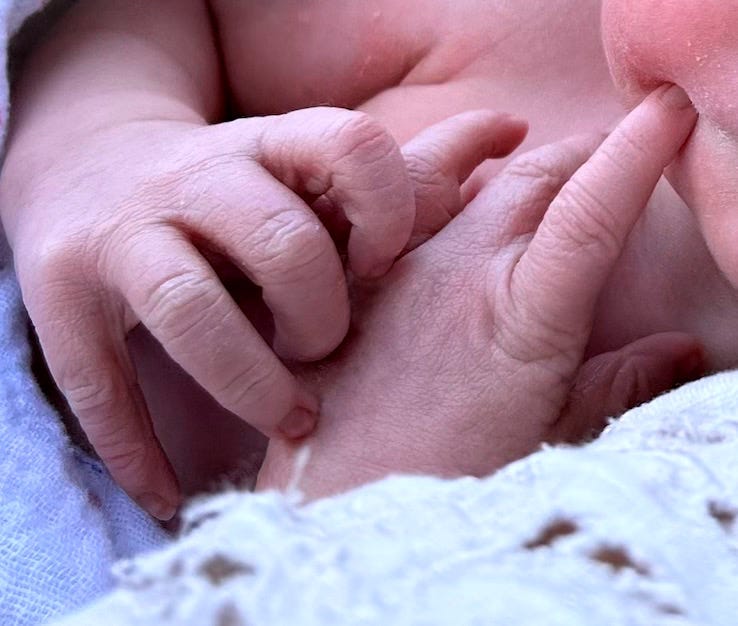
But right now, Lewis has a very short list of concerns. If he isn’t nursing, he is mostly either settling into sleep or sleeping. He makes his displeasure known, but his rants are short-lived. He has moments of pensive gazing, and episodes of gesticulating to the air.
For his first few days, his arms were unfolding, moving twitchily, flexing his perfect tiny fingers. Lately he has taken to exploring the space around his head, and off to the sides in both directions. Even within the frame of nearly a fortnight, his eyes are open more. He stares with that unblinking moist-eyed baby stare. Does he see in grayscale? Or more shapes and patterns of light and dark? Does he recognize my voice?
Impossible to imagine what he is going through. Figuring out the world, I guess, starts with learning how not to knock yourself in the face.
We were sitting around our dining table after dinner with a few friends who were stopping over for one night on their way south. Each of us had our cup of tea, and we collectively nibbled on green grapes and homemade biscotti. The conversation focused on various events in each of our lives, against the backdrop of current events, including the specter of AI.
“I won’t mind not being around to see how this all turns out,” said one of our guests, and I’m glad she did. In any group in the range of septuagenarians (people in their 70s, so you don’t have to look it up), inevitably someone says something along these lines.
“It’s not our world anymore.”
I would like to imagine Lewis reading about these days forty, fifty years from now and musing to himself, or to a group of his peers:
Look at all the quaint and esoteric issues my grandparents worried about. Climate change. Rising authoritarianism. The threat of AI. Income inequality. Declining bee populations. Micro-plastics. We have solved a lot of this. If they were alive now they wouldn’t believe the world today. How could they have anticipated any of what we are grappling with now? They would be very disoriented.
We were on the screened-in porch near sunset. His grandma was holding him, she talked to him, sang to him, asked questions. His eyes touched on hers now and then, but mostly he was staring over the top of her head to something profoundly new and stunning just to the right. I looked back to see what marvel it might be. There were two large shapes. One was dark and straight – the beam running across the top of the porch. The other was large, vast, and bright blue – the sky outside.
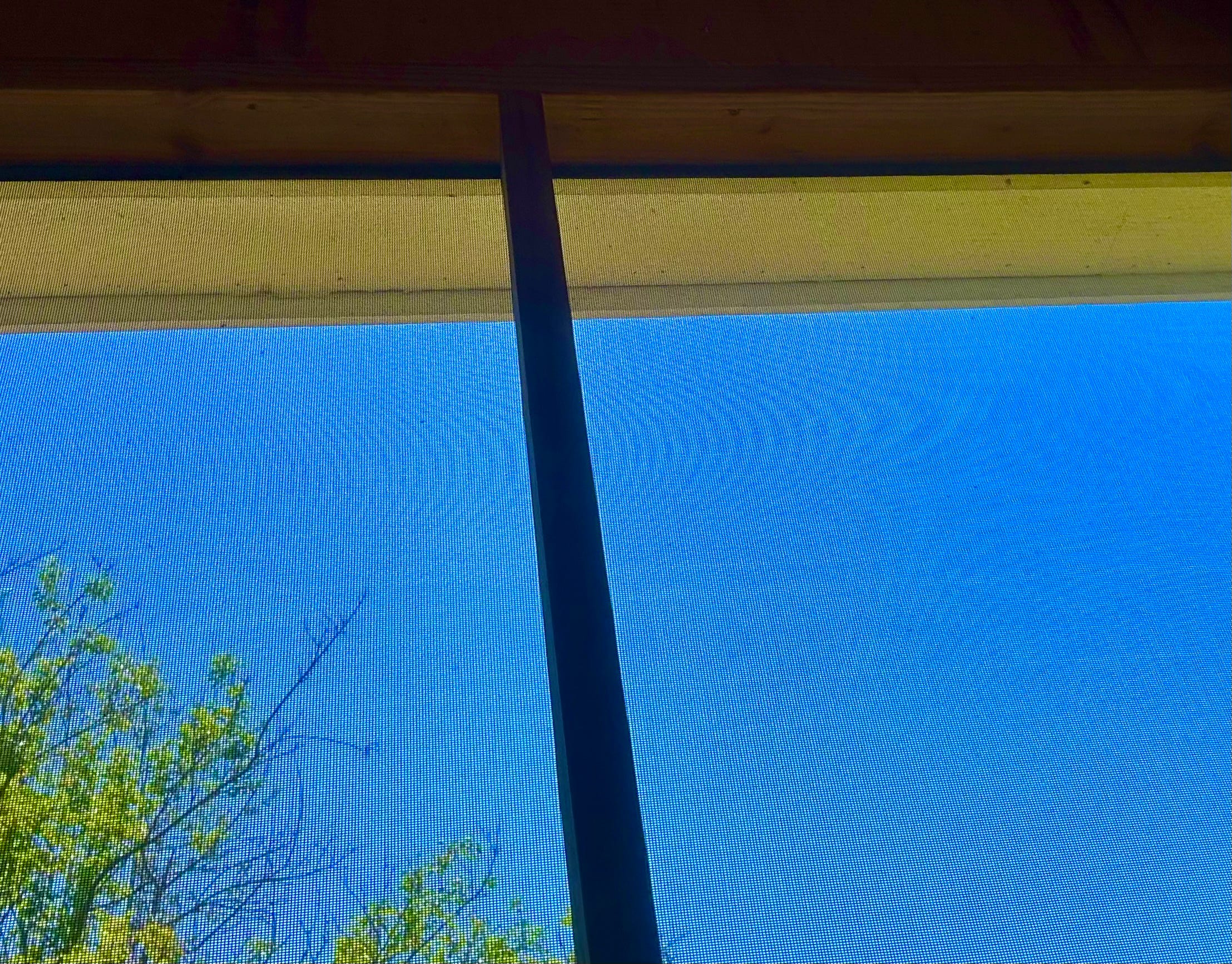
For the time being this person quiets the world he is coming to grips with, one grip at a time.
It might not be “ours” anymore. It’s not his yet.
But it will be. And that will be a good thing.

Just as Bronwen says! We stand in a large circle of love, outside the beautiful inner one, that has been awaiting Lewis' arrival. Welcome, little one. <3
Hi Stew - I enjoy so many of your writings but just wanted to say I particularly enjoyed this one! It was just so lovely and amusing how you talked about your new little addition to the family and his growing exploration of his still-little world. It's brave to pick up and move to whole new area at our age, but what possible better reason! Love to you all, Bronwen