

Scarcity doesn’t simply mean having less. The feeling of scarcity arrests the mind.
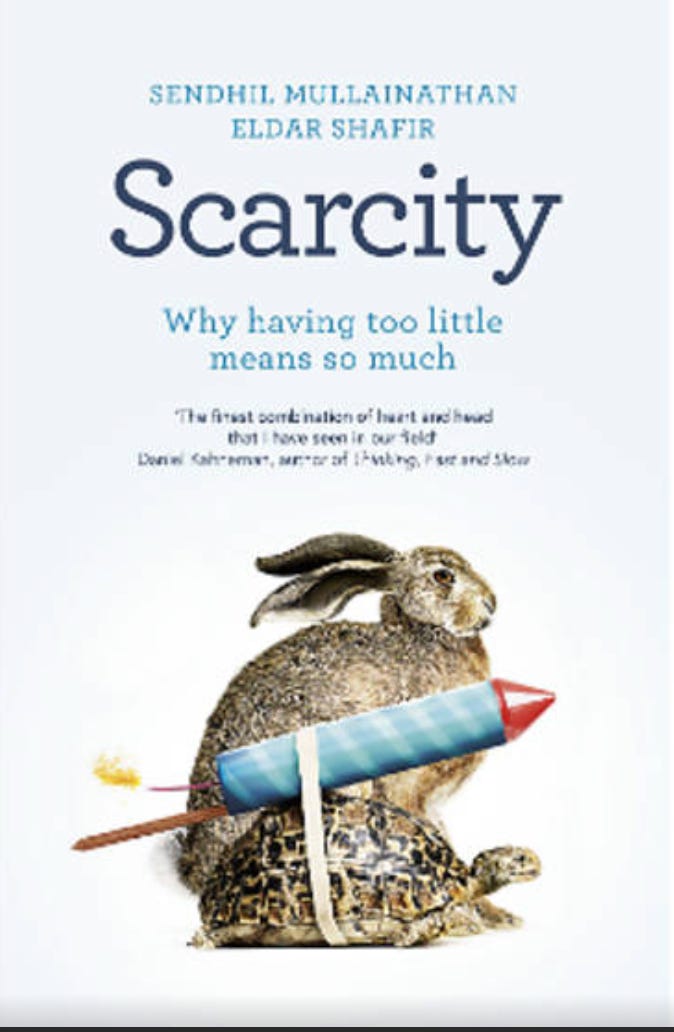
That’s the takeaway from the book by Sendhil Mullainathan and Eldar Shafir, Scarcity: why having too little means so much. (Times Books, 2013)
Whatever the scarcity — time, friendship, money, options, sleep, food, possibilities — the mind focuses intensely on what is scarce. Lots of brain cells trying to figure out how to find more of what’s missing. Lots of physical action, too, such as cramming last-minute tasks into a constantly diminishing space of time as the clock runs out.
What’s lost when our mind is captured by scarcity? Apparently, plenty.
We stop thinking strategically or long-term because we are faced with a shortage that must be addressed (or we believe must be addressed) immediately.
We don’t take time to plan. We are more reactive and less reflective.
We forget what we have learned from the last time we were confronted by this scarcity. Or, more accurately, we forget to take the time to think about what we learned.
We lose easy access to creative thinking and the ability to come up with options. I once heard a hospital vice president actually say to her senior team “We don’t know what we are doing, but we have to start now.”
Scarcity devours mental bandwidth. An American Psychological Association article here on the psychology of scarcity “explores how deprivation wreaks havoc on cognition and decision-making.”
A scarcity mindset might even make us less empathetic. Some researchers used a game setting in an experiment to induce a feeling of either abundance or scarcity: the former group was given 10 tokens for the game; the latter group was given 1 token. Each individual was then shown images depicting different types of human pain. The degree of empathetic response was measured. The article in the National Library of Medicine has this to say:
Behavioral and neural evidence suggests that inducing a scarcity mindset significantly dampens the ability to empathize with others’ pain. These findings shed light on our understanding of how a scarcity mindset may influence social emotions and behaviors.
Thinking you don’t have enough is the same as actually not having enough.
I would argue that this is a pillar of consumerism: to generate a cultural feeling of scarcity in order to compel the populace to buy stuff. This idea is not new. I remember reading The Hidden Persuaders in high school (Vance Packard, 1957). In the first chapter he talks about the difficulty in generating need (i.e., creating a sense of scarcity) in a country where many needs are already met:
As a nation we are already so rich that consumers are under no pressure of immediate necessity to buy a large share—perhaps as much as 40%—of what is produced, and the pressure will get progressively less in the years ahead.
If there is no immediate necessity, the consumerism machine must generate the need.
This book, you might imagine, was very popular with rising middle-class readers, and was vociferously panned by the advertising business as exaggeration and fear-mongering.
Packard, a journalist and social critic, describes a social and cultural shift he saw occurring, seven decades ago. He could be describing ideological and political polarization — stoked by social media — that now grips our country.
A very curious thing has been taking place in this country almost without our knowing it. In a country where individualism—independence and self-reliance—was the watchword for three centuries, the view is now coming to be accepted that the individual himself has no meaning except as a member of a group.
The above was published in 1957, sixty-nine years ago. I am old enough to remember when the term “rugged individualism” was used to define America. And the Marlboro Man.
Those days seem a far cry from the echo chambers of today, identity signaling, identity politics, etc.
In the past seven decades, consumerism has mined every advantage of the scarcity mindset. There are also examples aplenty of national leaders finding effective ways to stoke fear through “you are about to lose it all” rhetoric.
Even the most amateur dictator can see the value of instilling in the public a scarcity mindset.
First, convince people that they have been deprived of something of value — rights, attention, property, status, anything.
Then link the cause of that scarcity to a group of people — immigrants, allies, academics, liberals, anybody.
Lastly, promise the populace held under your thrall that an abundance of good will come their way only when the other tribe is vanquished. Then step back and let the warping power of the scarcity mindset quickly erode long-term thinking, thoughtful reflection, creative, generative thinking, and empathy.
Once those are out of the way, even a demented old man can garner a respectable following.
Next week (or the week after) let’s explore a more refreshing topic — the abundance mindset, and the benefits that accrue from its use.

A very interesting read - thank you Stew.
So much yes, Stew! This is the strategy used by so many political figures (not just the ones we disagree with), marketers, certain kinds of leaders. As soon as we allow ourselves to be sucked into the us/them binary, we become tools for furthering someone else's scarcity agenda. This line is a keeper: Thinking you don’t have enough is the same as actually not having enough.