

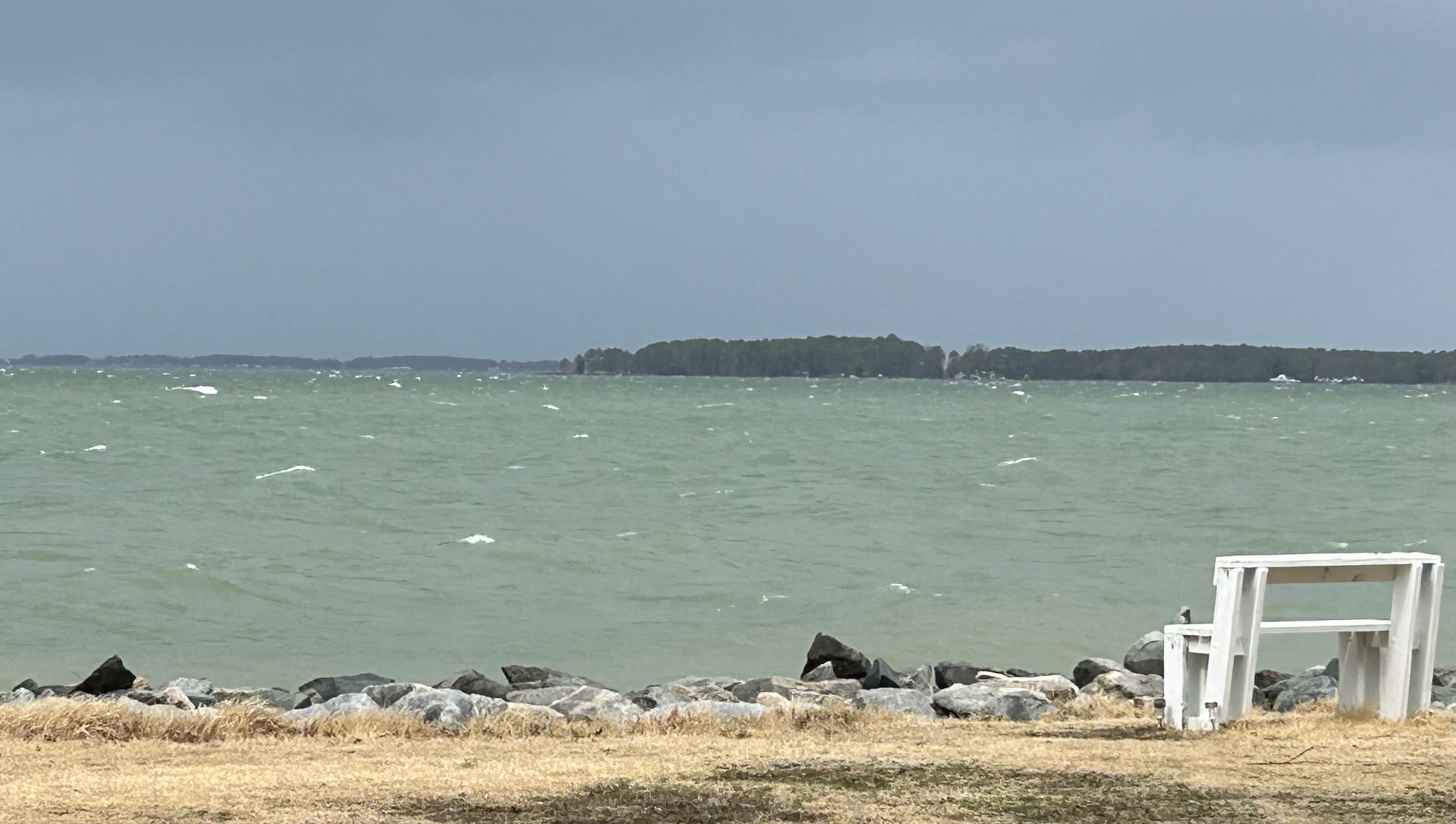
We are in a tornado watch situation here. The wind is pushing tiny green crests of waves south to north. The sky is an inscrutable gray. We watch and wait. In a few hours, winds will be gusting at 55mph. A large body of water lies to our west.
In this kind of uncertainty, it is hard to live in the moment. You know, the idea of mindfulness, living in the eternal Now, “Go with the flow,” etc.
I have always been perplexed by this philosophy — the idea that one is best served by being in the moment, viewing life with a kind of detachment, going with the flow. My first exposure to this manner of mental bearing was in high school when my mom introduced to the writing of Alan Watts, the British theologian and philosopher in his essay “Become What You Are,” in his book by the same name:
Life exists only at this very moment, and in this moment it is infinite and eternal. For the present moment is infinitely small; before we can measure it, it has gone, and yet it persists for ever. Called Tao by the Chinese, it is at once the eternally moving and eternally resting.
A few years later, my high school sweetheart gave me a copy of I Ching (The Book of Changes), the ancient Chinese divination text. My King Lear term paper analyzed the main characters in terms of the yin/yang duality. I practiced transcendental meditation in college (along with everybody), studied Eastern religion and philosophy, and learned about Tao, The Way.
Tao Te Ching (The Book of the Way and of Virtue), was written as early as the 4th century BCE and attributed to Lao-tzu whose historical existence is a matter of debate. Tao (translated as way, path, channel, path, or doctrine) is “indescribable and transcends all analysis and definition.”1
The Tao that can be trodden is not the enduring and unchanging Tao.
The name that can be named is not the enduring and unchanging name.
Having no name, it is the Originator of heaven and earth.
Lao-tzu, Tao Te Ching. (Trans. by Jame Legge unless noted)
The written word can not capture the real thing. The workings of the Way are hidden behind what we can observe.
One moves through life in accord with the Tao by practicing humility, simplicity, and detachment.
As I contemplate this idea, it sounds appealing. Living in accord with Tao means freeing oneself from the regrets of the past and from the concerns or fears of the future. All there is, is Now.
Living this kind of detachment as a way of life, however, is more of a challenge for the non-monks among us. Past and future follow us around everywhere - we regret, we plan, we worry, we anticipate, we yearn, we feel the bite of trespasses against us. Any moment in any given day contains more than just “Now.”
Each day we hear how “the stock market” is doing. The Dow is a proxy for economic enthusiasm. A sort of national mood ring. Is the market up? (We’re in the Money) Is it down? (Stormy Weather) Or ambiguous? (It Don’t Mean a Thing If It Ain’t Got That Swing)2
But this does not capture the real thing. The Dow is only what is observable, a line on a graph and a number.
On another app I can see the current value of my investments. They are currently down about 6% from their high two months ago.
But this does not capture the real thing either. It is only what is observable.
Situations like what is happening in the Middle East are serious and unsettling. Will the volatility persist? How long will it last before it passes away?
After violence there is peace. After loss there is gain.
What is and what is not create each other. Difficult and easy complement each other. Tall and short shape each other. High and low rest on each other. Voice and tone blend with each other. First and last follow each other. Lao-tzu, trans. Stefan Stenudd, taoistic.com)
Each day I name the things which bring forth my best care and attention. Even in these very words I strive to express my ideas, and I feel the effort of mind and heart to locate and pin down truth and true motive. Maybe I am trying too hard.
The Dow goes down again today, fleecing more of my financial flock by another couple percentage points. But this does not capture the real thing.
The world finds its collective economic footing, for now, in the midst of the chaos brought about by the unforced error of war.
He who displays himself does not shine;
he who asserts his own views is not distinguished;
he who vaunts himself does not find his merit acknowledged;
he who is self-conceited has no superiority allowed to him.
Lao-tzu
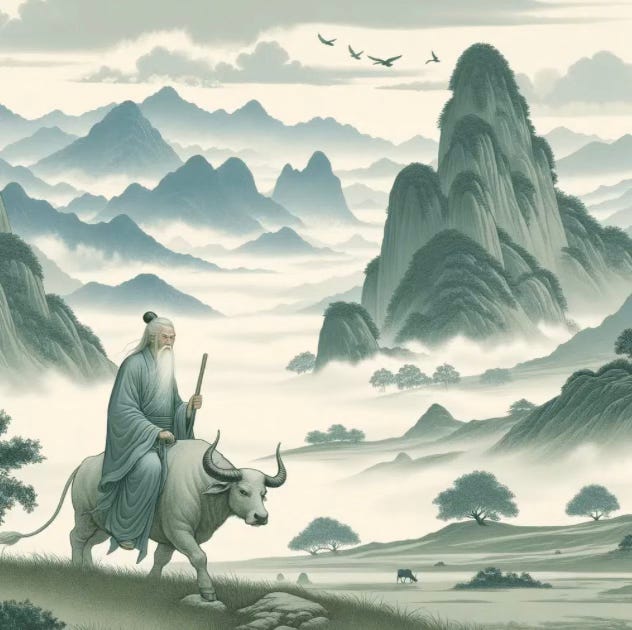
The Tao, the Way, asks us to be in the moment; indeed the Way exists in the moment. It asks us to understand that past regrets are not the real thing, that fears of what might come in the future are not the real thing. The Tao asks us to stop striving so much, stop yearning, stop fearing.
There is no guilt greater than to sanction ambition;
no calamity greater than to be discontented with one's lot;
no fault greater than the wish to be getting.
Therefore the sufficiency of contentment is an enduring and unchanging sufficiency.
Lao-tzu
The “sufficiency of contentment.” The quieting of the nervous soul. The finding of peace through focus. Here are some examples of this kind of practice:
The main character in The Way of the Pilgrim3 (a 19th century Russian story) seeks to discover the practice of “ceaseless praying.” This obscure text was popularized in the U.S. by J.D. Salinger’s Franny and Zooey (1961).
Hesychasm is a contemplative monastic tradition in the Eastern Christian traditions in which stillness (hēsychia) is sought through uninterrupted prayer.4
Many meditation practices focus on breathing as a way to keep one centered and in the moment. When the mind wanders (which it does), “return to the breath.”
The way of seeking the sufficiency of contentment is even in our popular music, beginning arguably with The Beatles. “The Inner Light” is a non-album single released in 1968 as the B-side to “Lady Madonna.” This George Harrison composition and performance draws heavily upon Eastern influences, with lyrics based on a passage from the Tao Te Ching, quoted here:
Without going outside his door, one understands (all that takes
place) under the sky; without looking out from his window, one sees
the Tao of Heaven. The farther that one goes out (from himself), the
less he knows. Lao-tzu
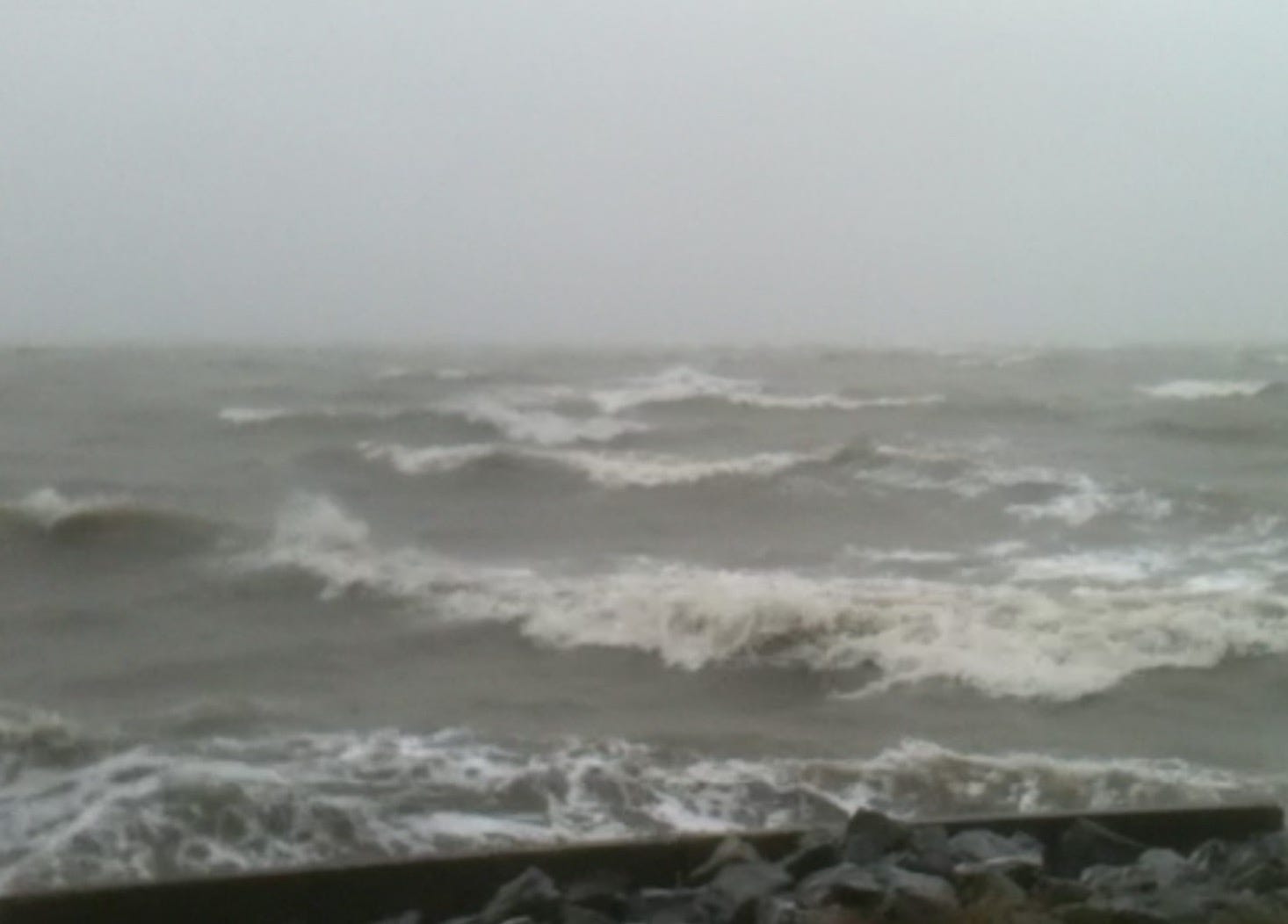
The storm came and went. The Dow ticked higher then lower. The warlords torment others and then they themselves are tormented. My spirits rise and fall.
This is only what is observable. It does not capture the real thing.
The Tao is (like) the emptiness of a vessel;
and in our employment of it we must be on our guard against all fulness.
We should blunt our sharp points,
and unravel the complications of things.
https://en.wikipedia.org/wiki/Tao_Te_Ching
APR’s Market Place radio program uses one of these three tunes each broadcast when they “do the [stock market] numbers.”
Ah, I believe you do understand what that baby on the tram was thinking. Inscrutable no longer. Baby mind. Baby consciousness. No past. No future. Only the present. Experiencing the moment. I'd say I miss those days, but then again I don't remember them.
I'm not a person who meditates regularly (or "successfully"). If I had more stock market investments, I might worry more than I already do. As happens with us so often, I've been thinking about activism, what it means to both live in the moment and have the hope of positive changes in the future. I think I could spend more time considering the concept that "Now" doesn't mean never considering the future, rather it means recognizing that nothing that has or will happen is anything other than a representation.
You might get a giggle from this:
https://www.youtube.com/watch?v=8DUqf5-LZo0