

Nicky Clayton, a bird scientist in the U.K., conducted an experiment with Eurasian Jays (members of the clever corvid, or crow, family). She fed female jays one type of larvae while the males watched. When it was the males’ turn to feed their mates, they always chose a type of food that their partners had not already had. The males seemed to be thinking about what their partner might prefer.
There is a profound suggestion here: that the corvid brain might be capable of empathy, of imagining what is going on in the mind of another being and thinking about the impact of their own actions on others.
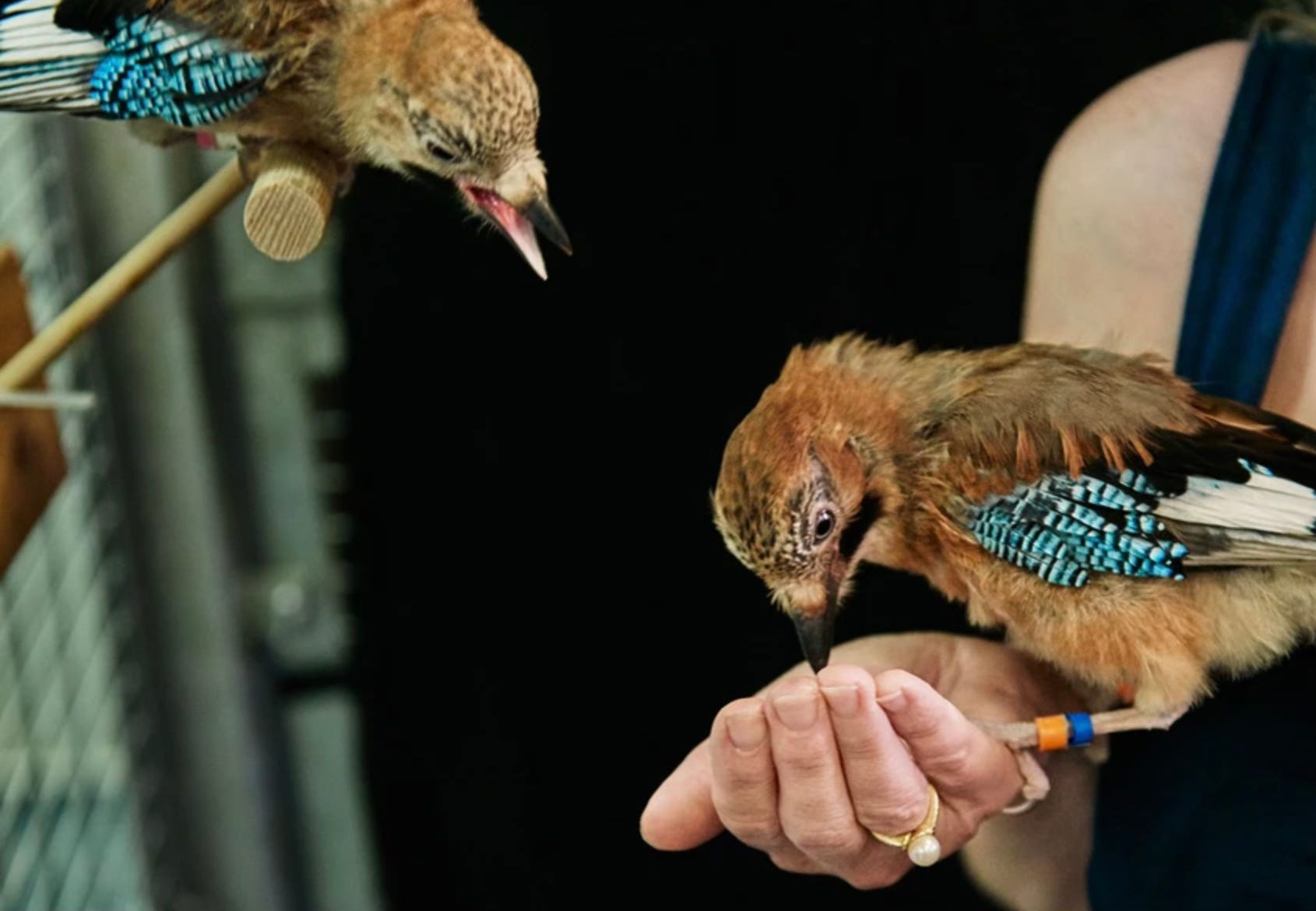
Researcher Nicky Clayton with captive Eurasian Jays. Photo: Trevor Ray Hart
Empathy can be a helpful human trait. We used to think it was exclusively human, and now we know that it appears in many species, even in a bird brain.
With empathy we humans can connect, derive pleasure from reading books and watching sports, hold meaningful dialogue, and share perspectives and thoughts. And with empathy, we can predict the impact of events and words on others.
We practice empathy every day. We can feel when it is present in the conversations we have with others – when we share information, stories and opinions. And we can feel when it is missing, for instance, in encounters that leave us feeling intimidated, ignored or humiliated. We can feel it missing from much of our political dialogue, certainly. The national tenor of conversations, debates, and dialogue is unprecedentedly shrill and mean.
The moment when civility is absent can be disheartening and frightening for those who don’t understand that the other side has taken off the gloves and has moved suddenly from friendly conversation to what I would term hostile zeal – a kind of assertion of a point of view that is forceful, uncompromising and uncaring about the impact on others.1
It is this phenomenon — the rise and acceptance of hostile zeal — that might compromise a foundational tool of civilization: civil discourse.
Civil discourse is the engagement in conversation intended to enhance understanding. We introduce children early on to the art of civil discourse. It starts with some basic ideas or rules that we all know. “Use your inside voice,” “Slow down so I can understand you,” and “Don’t interrupt; let your sister finish her sentence,” are examples we might hear around the house. In school we might hear “Who haven’t we heard from?” and “Let’s see if we can talk this through.” You get the idea.
These kinds of statements aim to ensure that:
voices are heard,
people and ideas are respected,
tone and force are proportionate to the situation and
interpersonal connections are preserved or enhanced.
From these foundational values have evolved applications at every grade level: elementary school students trained in conflict resolution skills for the playground; social skills workshops in middle school to teach empathy and encourage self-control; the use of restorative justice practices in high school; a focus at all ages on mindfulness and centering as a way to decrease stress and build resiliency.
Clearly, we value these things in schools and homes: inclusion, respect for people, and a sense (through empathy) of the appropriateness of tone and force in different social situations.
We also value, as a nation, the robust debate, the open sharing of views, and the validity of vigorous disagreement on issues.
Yet in public discourse we seem to lack the wherewithal to talk constructively about our difference of views.
I found this little diagram called “Ways of Talking” in connection with my work as an organization development specialist for Human Resources at Johns Hopkins Hospital in the late 1900s:
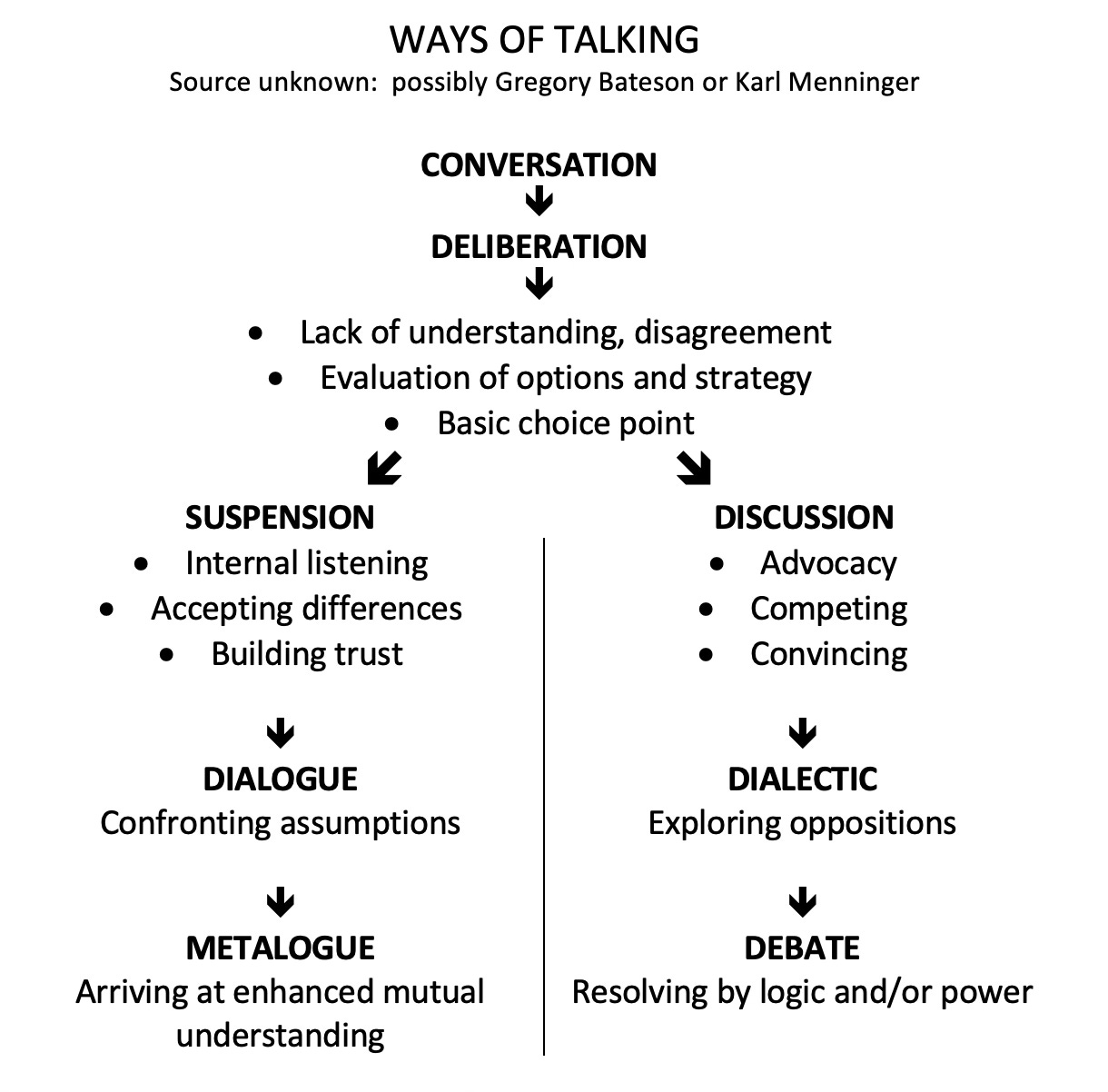
Most people are familiar with the process on the right-hand side of the model; we are taught through the educational process to advocate and defend our point of view. Many professions are siloed into areas of expertise. You have a problem. I have knowledge and experience. Your role is to listen. To me. Society reinforces this talent (of expressing opinions) through the celebration of one-sided takes, whether coarse, indignant, and simplistically certain, as in the ecosystem that followed Rush Limbaugh, or polished, ironic, and researched, as exemplified by John Oliver.
Advocate/Compete/Convince can, in extreme cases, be manifested as an act of violence, causing the person on the receiving end to feel humiliated, flee for safety, or fight back.
In one sense, the Advocate/Compete/Convince approach, and resolving the conversation by power (or intimidation and abuse) is easy and efficient (for the advocate) as long as the advocate doesn’t care about – or see the relevance of, or have the skills to pursue behaviors that lend themselves to – building relationships with other people.
The approach on the left-side is more nuanced, and less instinctive for many than the right-side path. The behaviors of listening, accepting and trust-building are all derived from an interest in the act of inquiry, which is based on having curiosity as a mindset.
The curiosity mindset is not dramatic. It relishes sharing of viewpoints, not “take downs.” It marvels at the variety of human thinking, not narrow rightness; it is broad, not truncated. It is arguably the result of empathy and imagination.
We need both Advocacy and Inquiry; but while the former is easily grasped, practiced and rewarded, the latter might be in a state of atrophy and in need of rehabilitation.
Maybe we can see the antics of a crow (with her walnut-sized brain, demonstrating empathic thinking and behavior) as a call for all of us to “up our game,” so to speak. Sometimes it feels as if the art of inquiry, and the attendant skills of curiosity and empathy are at risk, even in our conversations.
I believe we can strengthen our empathy and our caring – things many of us learn while young and maybe lose sight of.
We can be better than children, in this regard, and certainly better than crows.
At stake is civil discourse and the benefits that will accrue with our evolved understanding of each other — in the wide, troubled world, and at our own hearth and table.
I have written previously about the skill of advocating for a point of view and the skill of inquiry, asking questions, exploring assumptions, etc. (I Am Right and You Are Wrong1: the fickle power of opinion, March 25, 2025). My title is shamelessly borrowed from the book I Am Right, You Are Wrong: see all points of view and make better decisions in which “lateral thinking guru Edward de Bono challenges this ‘rock logic’ of rigid categories and point scoring arguments, which is both destructive and exhausting.”
Bravo, Stew! Not that protests don't have their place, but could we please launch nationwide trainings in civil discourse?
I've had the recent privilege, at work, to participate in a series of six one-hour sessions on Compassionate Communication across the last 6-8 months. The facilitator, a colleague, is deeply trained in conflict resolution and mediation. Today's final workshop was on apologizing, an action (behavior, art?) that, done well, is rooted in empathy. Right up your alley! In my follow-up evaluation I said I think this kind of training should be mandatory. We need it well past our school years.
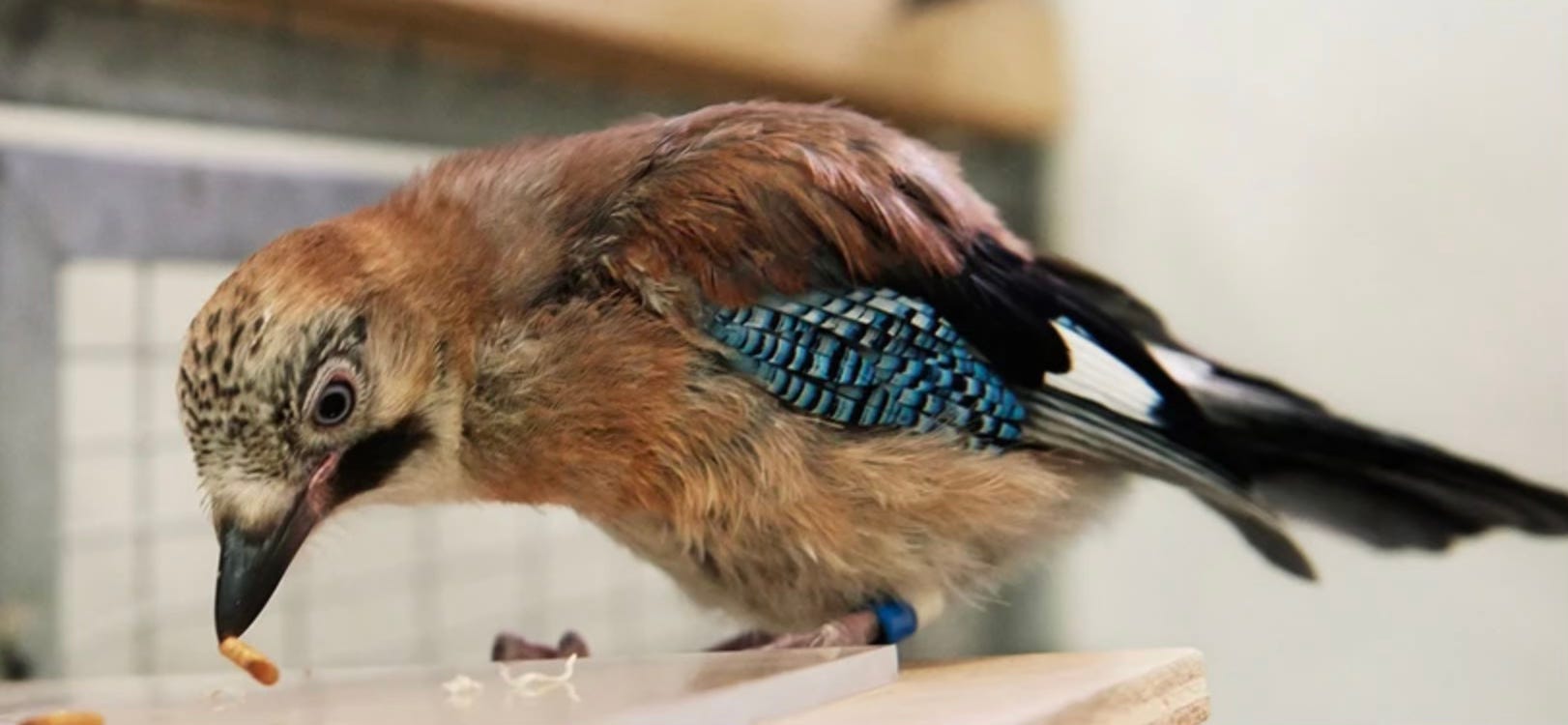
Also, Eurasian Jays. Gah! They're so beautiful. Before now, I didn't know Blue Jays were in the corvid family. I'm also super curious about why the birds in the photo don't seem to look anything like this: https://en.wikipedia.org/wiki/Eurasian_jay#/media/File:Garrulus_glandarius_1_Luc_Viatour.jpg