

The article in wikiHow about how to become a content creator has this suggestion:
To get started as a content creator, focus on creating content you enjoy.
Build a following by connecting with others who share your interests.
As far as we can tell, the original content creator didn’t have any followers but really loved hydrogen and helium. One theory is that just after the creation of neutrons, protons and electrons, the content of the universe was hydrogen and helium nuclei for a very long time (380,000 years) until the first atoms formed. Then stars (collections of hydrogen and helium atoms). Then galaxies (collections of stars). It was an enormous enterprise.
This primal content creator gave us time-space, the pressure-cooker of star power to create all the other elements, and a host of physical properties governing the very large and the very small. I picture one of those huge detective walls with tacked note cards and lines of string showing all the interconnections, dependencies and processes. But instead of helping solve a crime, the diagram helps plan the content, the story of the universe.
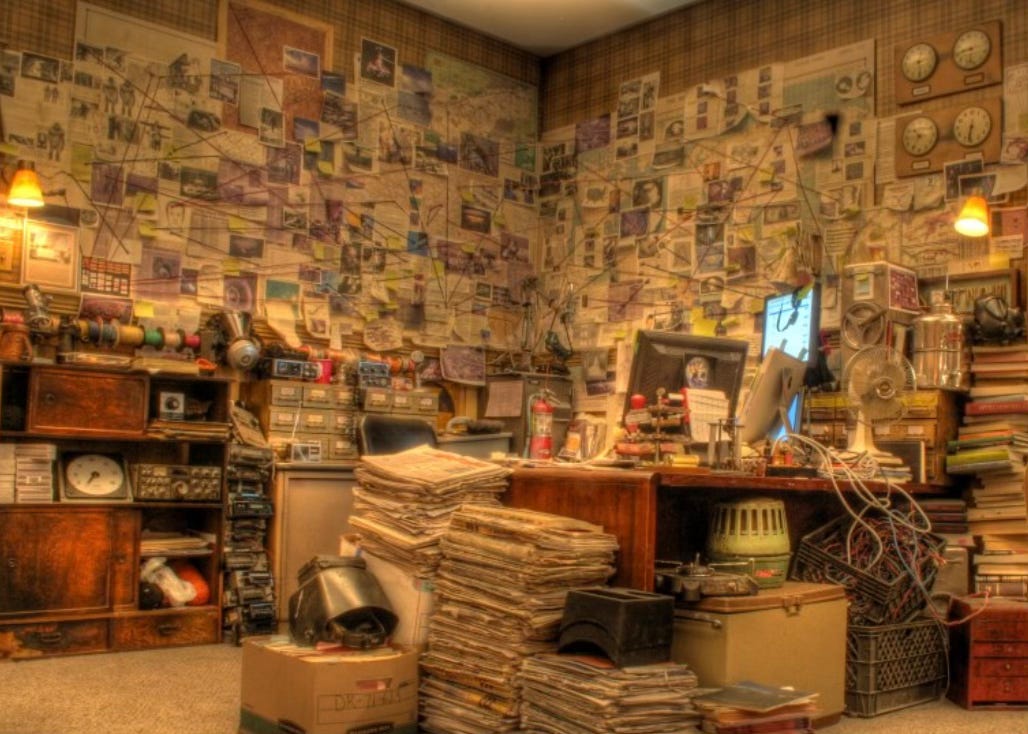
This content creator’s interests clearly lie in physics, thermodynamics, chemistry, and the mathematics that underpin the rules of this massive undertaking.
But things were about to change. Among the trillions of galaxies (each speeding away from each other like dots on an ever-expanding balloon), there was this one spiral galaxy. On one of its outer arms sits a modest star, and around the star spins a huge cloud of debris which over time accreted through the force of gravity and laws of motion to form distinct rocky planets that orbited around the star.
The third rock from this star was the focus of a second content creator, whose interests lay not in the spinning orbs and grand sweep of universal laws played out among the stars and galaxies. This content creator was focused on amino acids which happened to form in the primordial soup on the surface of this damp ball of rock.
This was the original “start from scratch.” I imagine the key to success was the enormous number of trials needed to transform non-living materials into the common ancestor. This content creator only had the content from the first content creator, and that creator took a long time to set up the mathematical and physical laws that set everything in motion. All the errors on the way to success were left in the primordial dust.
The only thing that worked was the thing that worked.
And when the whole “life” thing really got underway — blue-green algae, single cell organisms, viruses — all this content went… well, viral. The fossil record we have now doesn’t do justice to the fecundity of this content through time. But just look around today. We’ve got bacteria, brachiopods, bivalves, Brussel sprouts, button bushes, bats, birds, bamboo, bumble bees, buffalo. You name it. And many you can’t name.
Each slight variation was better than the previous one. This creative had found their niche in the idea of a replicable cell that would eventually evolve into everything living.
There were hiccups along the way. For instance, 97% of all species on the earth were inexplicably wiped out 250 million years ago, an event known as the Permian Extinction or the Great Dying1. This was one of five mass extinctions.
The fact that life never lost its footing entirely is a tribute to that second content creator. They got something right — a universal genetic code, the capacity of cells to make proteins, and ATP (adenosine triphosphate), the “molecular unit of currency”2 for intracellular energy transfer for all living cells since the beginning of the first life on earth.
But things were about to change again. This relatively recent newcomer was different in ways that set it apart in some very significant ways from the other 11 million species with whom it shares this rock.
This change required a whole new content creator, whose focus would be a complex mammal. This new species had opposable thumbs, a brain that can visualize and weigh alternative scenarios and pick the one most favorable, an uncanny ability to build tools and “ratchet up”3 innovations across generations. Some scientists identify the “cumulative culture” as a distinctly human process. We don’t have to rethink everything when one generation passes away.
The combined result of these three content creators? The first gave us the void of space punctuated by squiggles of galaxies as far as whatever distance we can see. The second gave us the (hypothesized) latest common ancestral cell population from which all subsequent life forms descended.4 The third gave a species with the capacity for all forms of music, art, science, engineering, literature, law, industry. You name it.
And war, weapons. What other species sets upon one another in this manner? Motives vary. Defensive actions often seem good and just, to stop for instance a ruler who is indisputably evil, or to throw off the bonds of repression.
On the other hand, “liberating our historic lands” (Putin in the Moscow Times) is a questionable motive. As is the weaponization of religious faith to justify colonization and genocide.
In the opening scene of Kubrick’s 2001: A Space Odyssey, two tribes of hominids shout at each other over control of the water hole. One day, an elder ape (“Stargazer” in the book) figured out how to use a large bone to bludgeon to death the leader of the opposition. In a short million years or so we have nuclear weapons. That’s cumulative culture at its most fierce.
Sligo Creek Parkway (in Silver Spring, MD) has a lovely trail that winds gently between the creek and the roadway under the cover of tall trees. My dog Sienna and I took a walk along part of it earlier this week. At each bridge crossing we would pause to look at the water making its slow journey through the rocky creek bed. I thought about the beauty of the inanimate world.
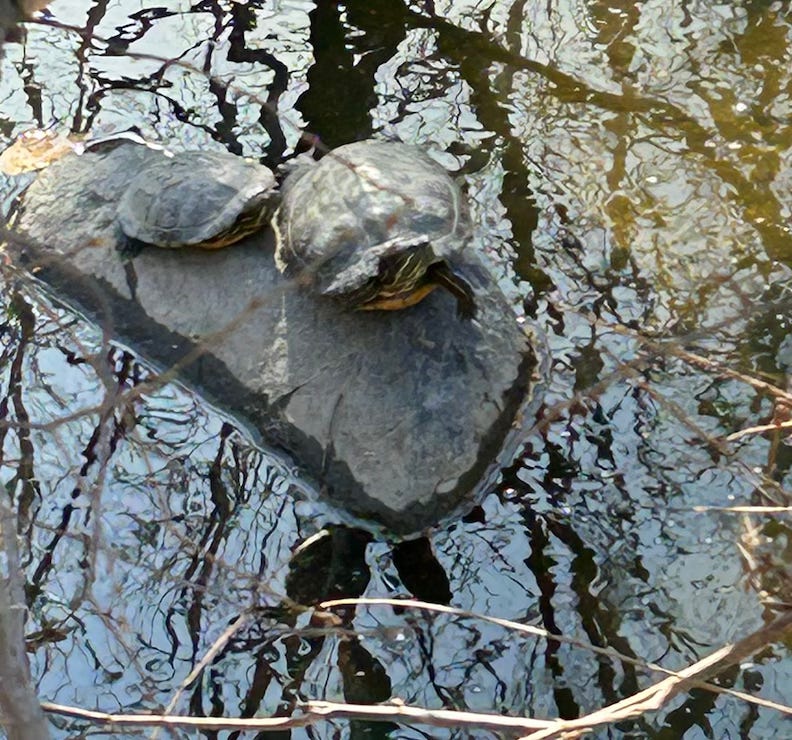
I spied two turtles basking on a rounded stone poking up from the sliding water. Once a long time ago life was set in motion that would in time bring about these turtles in this habitat.
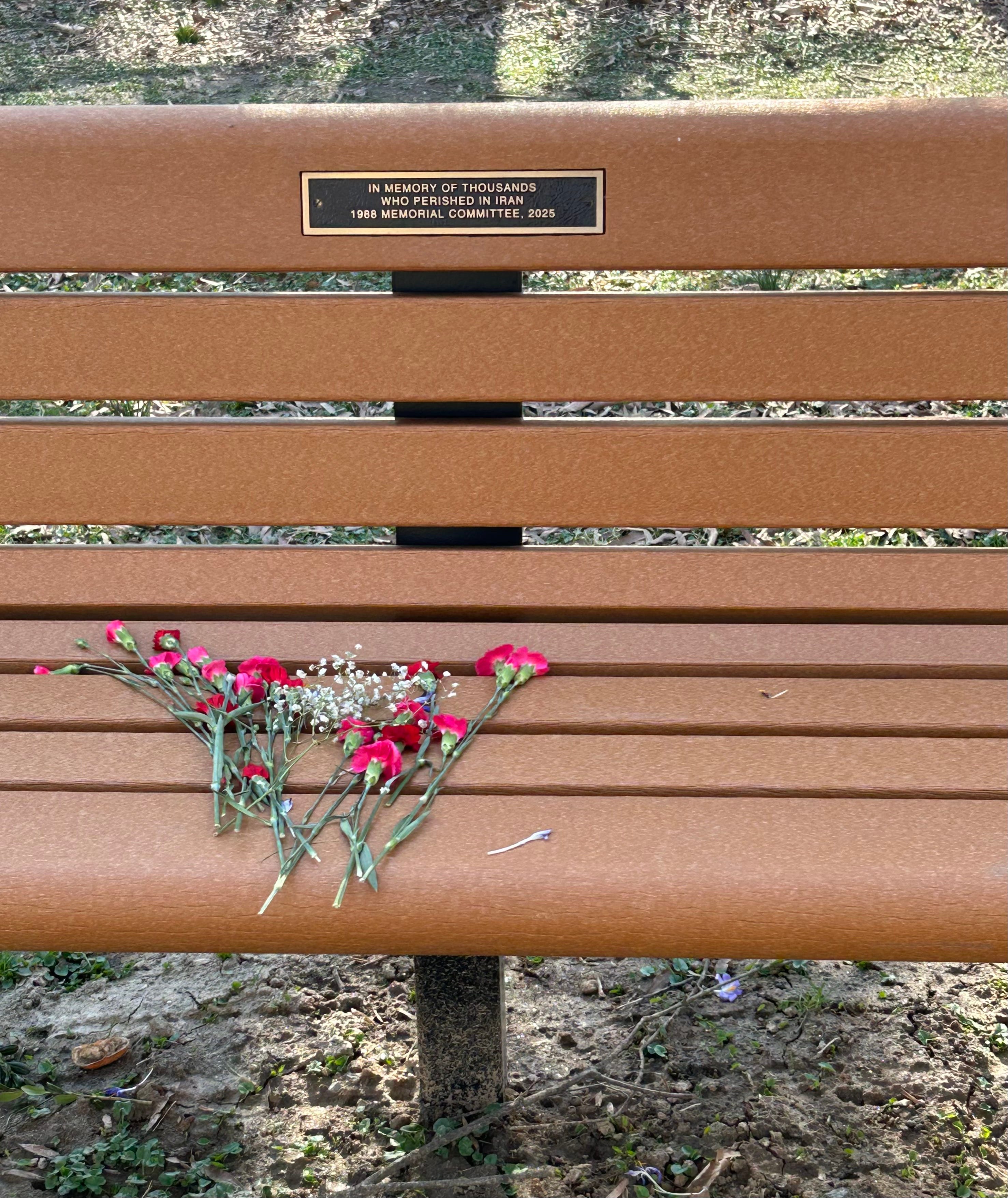
There are benches here and there along the trail, and on our return to the car I spied one newly installed. There was a small dedication5 on it, and a small pile of wildflowers on the seat.
I will leave you each to think about the kinds of beauty that humans have been able to create. What comes to your mind that illustrates the best we can be?
As for killing each other, persecutions, this war thing — it often comes down to a very few people (men) with unchecked authority and sublimated fear whose creative imaginations have utterly failed. They fall back on violence to assert their… whatever, fill in the blank.
And they fight wars with other people’s bones.
Me? Give me my rock in the sun, some music and a good book.
Ratcheting up the ratchet: on the evolution of cumulative culture, NIH National Library of Medicine
More on the Last Universal Common Ancestor (LUCA) here in Wikipedia and here at Nature.com. The authors posit that “the common ancestry of all extant cellular life is evidenced by the universal genetic code, machinery for protein synthesis, shared chirality of the almost-universal set of 20 amino acids and use of ATP as a common energy currency.”
Hi Stew, I really enjoyed reading your post. Question: Should the asteroid that wiped out the dinosaurs be considered a content creator? I don't suppose hominid content creators would have evolved otherwise.
Such a creative metaphor! So many origin stories attribute it all to just one supreme being; it was interesting to credit three distinct creators. I really appreciate how the piece ends with a simple walk by the creek. After all the complexity of the universe and life, that scene feels like a good answer in itself—sunlight, water moving over stones, and a moment to notice it. That's a form of content creation in and of itself, is it not?