

I will miss these trees, mostly. I know, the next place I live will have forests and trails, parkland and rivers. But there is something about these few wooded acres that follow the local stream. Our house is perched on the hillside, with a view of trees along the stream towering over the houses on the other side of the street. I mean towering. These are old poplar, oak and American plane trees (which I have mistakenly referred to as sycamore for years).
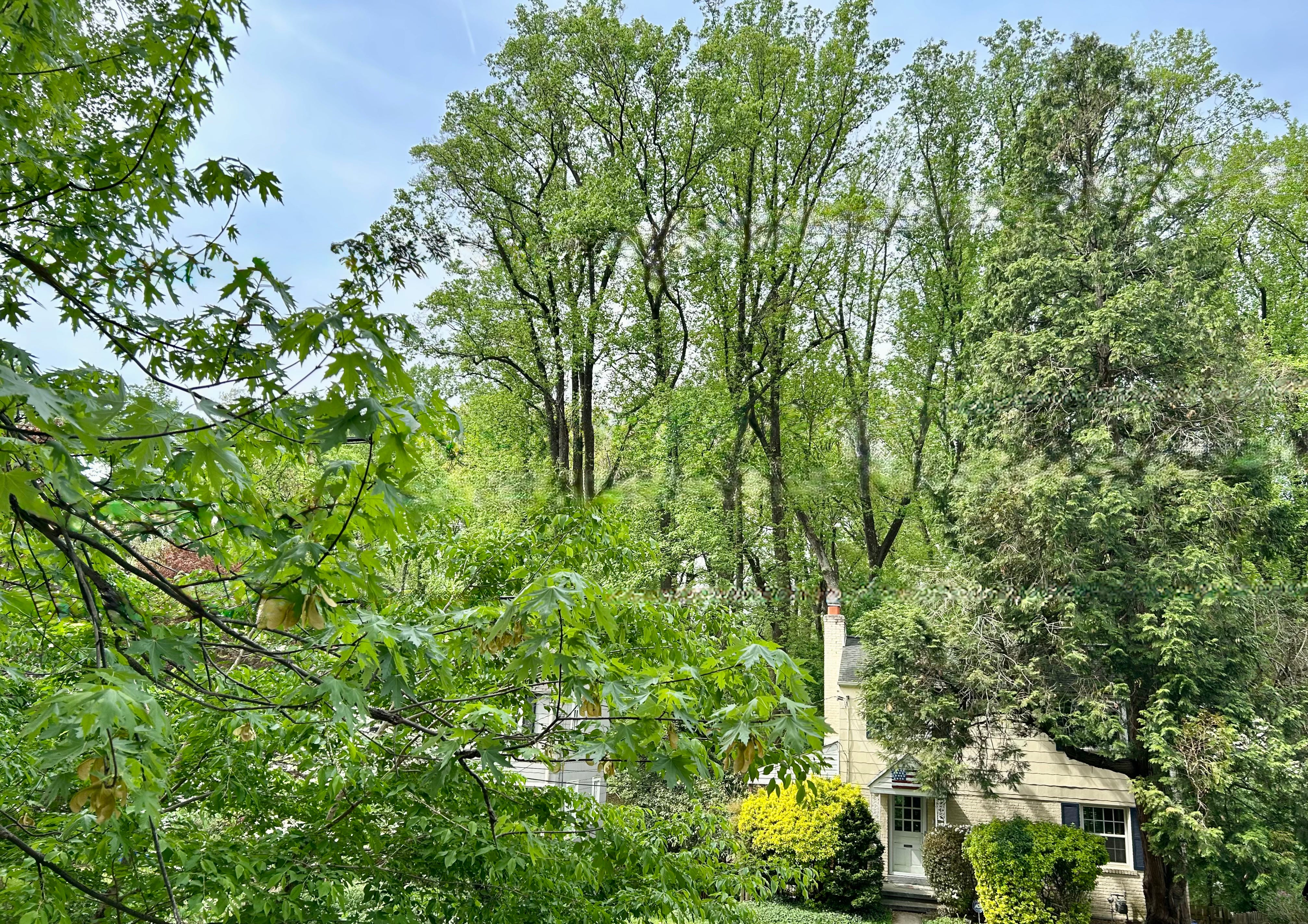
We close today, Thursday. We move Saturday. There are a lot of moving pieces. A lot of long inner good-byes that don’t have words. I need to call upon a story from my past. To get some perspective. I hope you understand, Gentle Reader.
I wrote an essay in June 1998, after I visited the home of my childhood. Earlier that month neighborhoods in the northern suburbs of Wilmington were subjected to a microburst — a sudden, violent downdraft of air that accompanied a particularly vicious thunderstorm.
A tree fell into the house where my pal John lived when we were young. And the woods behind our old house at 23 Briar Road had been leveled. I visited the site, following a sense of obligation to witness the devastation that had been meted out upon the sylvan backdrop of my childhood.
Here is the essay, edited for length.
Most of the trees I had ever really known as a child were knocked over one night recently, so I went to see what it looked like. These were the woods behind the house where I grew up. Less than a quarter acre, the woods could hardly qualify as a disaster area; but in its compact assembly of mature trees, undergrowth, paths and woodpiles, it contained the stuff of almost a quarter century of activity. I came to the site feeling like an archivist, hunting for a catchment of memory.
I’ll just take a peek. Just to the edge of the house, I thought. Just along the garden.
Something pulled me in, past the edge of the house, in toward what had been the edge of the woods. What had been a lush backdrop of green was gone, decimated, swept, raked over. As when an actual rake, thoughtlessly drawn over a patch of small blossoms, will push over many of them and ruin horribly the uniform spread and tiny altitude of those flowers, so to oaks, and maple and poplar did this recent wind wreak havoc.
Some were standing. I noted them as I drifted in a mix of mourning and fascination toward that woods — moving toward a place at which I would never arrive. Where was the single white rose by the ash tree? The rhododendron? Where was the forest edge? How did a 100mph downdraft remove this precise grove of trees while leaving all the houses around it intact?
A few neighbors in the development behind ours moved slowly across their back yards, gathering and moving branches to one side. They can see me, and I them, because the green is gone. It reminds me of jungle deforestation in the Philippines; whatever lushness there was stops at the edge of human enterprise. Perhaps a hundred feet back across the devastation, the woods suddenly resume, as dense and green as I remember it.
I walked toward the back porch, toward the person moving to greet me, who, I would soon find out, was the owner of 23 Briar Road, Ms. Steele. I introduced myself and explained my mission. She told me the story of that weird and frightful night. Thunder cracked and incessant lightning popped like flashbulbs. The entire family migrated to the basement for safety. Then, in the riot of wind and hail, a seismic thud — a grove of old-growth trees being swiped down in a second.
In the ensuing conversation, we put the woods back together, its history since they moved in, and before we moved out. We watched the neighbors move branches and piles from here to there. Ms. Steele would invite me, my mom, and my children Andy (12) and Hannah (10) to tour the inside of the house, my first view of it in eighteen years.
I never saw the woods for the first time; it was always there. I was six months old in May 1955 when my family moved to 23 Briar Road, and at that point ours was one of two houses on a quarter mile long cul-de-sac off Wilson Road. This development, to which my mom would give the name Briarwood, had, at my earliest memory (circa 1958), only 13 houses, numbered 1, 3, 5, 10, 11, 12, 13, 14, 15, 16, 17, 21 and ours. The other 10 lots were empty.
Over the course of the next decade the sapling growth would give way, one by one, to houses, but the woods behind us and in the lot to the west of us, remained — sort of a legacy of the forest, orchard and farmland which all this land was before the Great World Wars. This woods, positioned as it was at the end of the cul-de-sac, was exempt from development. It was my backdrop, a canopy, an enclosure, a hug of green. A corner of peace and sustainability, amidst the change of suburban sprawl, of the riotous 1960s, of my own growth, toddler, teen to man.
Year upon year, in much the same way the woods would shake its bare branches against the cold darkness, and hold and bounce sunlight in the summer, or carry the wood thrush call. The Woods just Were, year upon year.
As much as the trees defined the space, I marked the area in my child’s mind by paths and clearings. Here is where woodpile was, and the old hammock, and here between oak and maple we put the new one. The trapeze hung off the slanting red oak, and past that point a path led back to the clearing where the two trees grew together. Way beyond that (and well off our property) was Big Rock, a dark basalt landmark indicating time to turn back.
Directly behind the house there were the four sassafras trees of uniform height, forming a rectangle that invited construction of various forts. From there a path parallel to the fence brought one, within a few steps, to the stables of imaginary horses, a mote, a meeting room, a tunnel behind the viburnum and another clearing where we would spring from the split rail fence and swing off a sweet gum tree branch. This last spot was near the end of the driveway, where stood the tulip poplar – one of the few great climbing trees in the constellation.
This path along the fence followed, we later ascertained, an old drainage ditch which one could follow past the sassafras, past the birch trees, to a low area behind the double tree where, each of Hickman children swear, there once was a small marshy area. I thought there was running water there at one time. Pat remembers salamanders and guppies. That part of the woods, the clearing, was always dense and cool.
The double tree was now on its side, blown down to the northeast along with its companions: two white oaks, the maples, others. The woods was a confusion of snapped trunks, northeast-blown trees, huge rounds of bleached roots clung with light gray and yellowish soil, many taller than I. What remained of the underbrush were a few stems with sparse leaves turned the wrong way. The red oak, which grew at a southwest slant, stood still, all but three stout limbs busted off, and of them only one had leaves to speak of.
Near the trapeze was the spicebush. Dad had shown us children how to spot its oval leaves which, when crushed between your fingers, imparted a sweet smell. That was thirty years ago. I picked one leaf, rolled it in my fingers and kept its fading fragrance in my hand.
Standing in the woods, the echoes of past activities seemed particularly faint, my feet and body particularly large on this stage where so many small events happened: singing with my sisters as we raked leaves; the hammock; the few campfires near the split tree; setting off firecrackers; building the sassafras forts; raking out clearings and paths and passages and meeting rooms and the hideaways; tending the animal graveyard, resting place of beasts wild and domestic, just behind the maple in the yard. The beginning of my nature watching. Naming bird tunes. Noting the color of bark.
There is nothing really to do but reflect, the magic having been completed sometime earlier when I wasn’t looking.
I remembered the trees as footprints where they stood, and as billows where they lived in the air as blended clouds of distinct texture and shape. Even on this sad day, I move around the blasted landscape as I felt I should, a pilgrim coming home.
Ms. Steele and I find some solace in remembering the woods, but the pain is deep, the ruination too fresh. No one was hurt, but the Steeles keep the living room window curtain closed in mourning.
Seventeen years later I paid another visit. Ms Steele was happy to say that trees were coming back. She had the curtains open.
So lovely Stew. Reads like poetry. Mournful. Beautiful.
Our small selves hold such huge trees, sprawling views. I love being able to look back through the circles of all the seasons. Have a good day tomorrow. Come back to this home often, please. (Audrey)