

A good friend and colleague of mine, the late Joe Chamberlin1 of Baltimore, had a few stock phrases that found their way into his repertoire of conversational antics. On one occasion, he was going on at length about something amusing that happened over the weekend. Always socially self-aware, he came up with this immortal line:
But enough about me. Let’s talk about you. Have you read my book?
Classic Chamberlin. In three short sentences he captured a phenomenon that I have been studying most of my adult life: the tendency of some people, when in conversation with others, to talk at length as if it were a deposition and not a social chat. I don’t know if this is due to some kind of conversation insecurity. It could be a social habit. Or a handy way to control a social exchange that might, without their intervention, just go off in any direction. As conversations often do. Maybe it is a symptom of social anxiety.
One gentleman I know was talkative because he was hard of hearing — so listening was difficult, and therefore he tended to do most of the talking. Fortunately, he was also an excellent storyteller.
A couple decades ago, we had a loquacious neighbor, where it was wise to have an exit plan before entering into an exchange. I was taking care of a friend’s dog at the time (named Bumpy, a great and patient hound). I had had several pleasant enough exchanges with this neighbor in the past. He was in his yard and we exchanged salutations, and approached me as I tried to continue past his house. He made an initial probe to see if I had visited the Air and Space Museum recently. I don’t remember my reply and I don’t think it affected his presentation. At the ten-minute mark it was clear to me that he was just getting started.
All that I took away from that close encounter was a moment of breath-taking irony, a phrase printed on the front of his T-shirt: “Can you skip to the part where I care?” You can’t script this stuff.
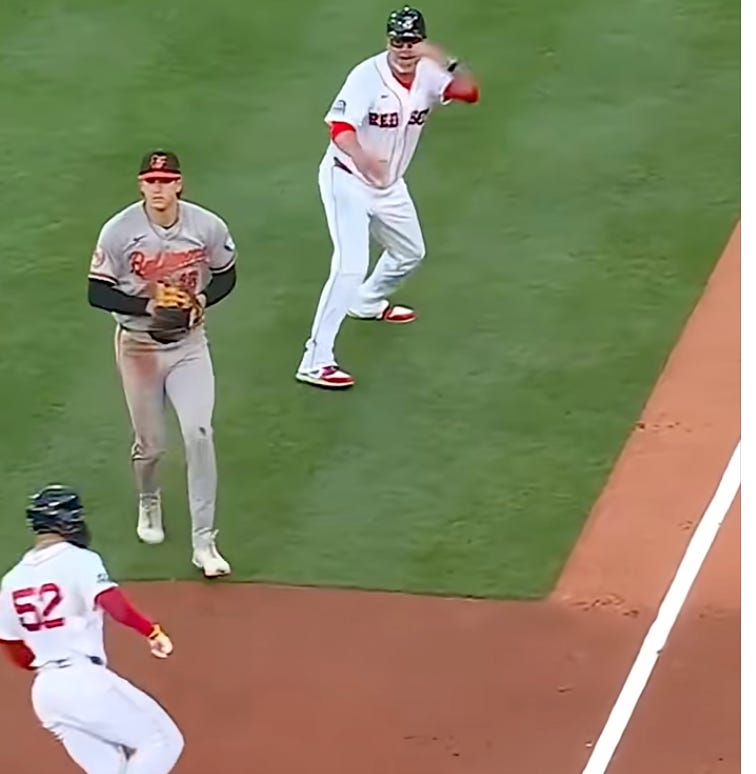
To be honest, my skills as a good listener work against me in situations like this. After decades of being me, I have over-developed some key attention behaviors, such as nodding, and making affirmative and empathetic noises when someone is talking. But what I really excel at is asking questions — which is the conversational equivalent of waving the runner home in baseball, except there is no home plate so he just keeps running around and around.
If I were sixty years younger, I suppose I would also use the silent applause with my thumb and index finger. (“Clock it”? I would need to ask a youth to affirm my use of the idiom which indicates that one notices, recognizes or grasps something. Which clearly I don’t because I was born in the nineteen hundreds.)

There are so many examples of social prolixity2, it’s difficult to choose — but the company picnic stands out. You get to know your colleagues in such festive settings, but you also meet their spouses. I initiated talking with the spouse of a woman with whom I had traveled to Tunisia for some UN contract work some months earlier. I didn’t have an exit strategy, so I have only myself to blame. Apparently I listened so well that I received, over the course of a 45-minute monologue, the party conversation equivalent of a master class in catfishing in Louisiana. For days I was a walking Wiki on the topic: the prime locations he frequents; the salient characteristics of the Blue, Channel and Flathead catfish, their habitats and preferences; lures and techniques; an outline of the typical day in one-hour increments; the type of boat he uses; and the history of the Atchafalaya Basin, all sprinkled with anecdotes about the best catches, and favorite catfish recipes.

Was this an Ancient Mariner situation, where he is destined to roam the earth repeating the same story of his quest for catfish, and I am left, like the wedding-guest, “a sadder but wiser man”?
I doubt it.

My Uncle Paul had a lesson in listening that he steadfastly practiced at the dinner table when my three cousins were young. If any child went on at length with any kind of rambling story (as children do) Uncle Paul would gently intervene with his calm and measured voice: “It’s time to ask a question.” I guess now we would call that strategy “redirection,” but I believe he was making a larger point about the value of a back and forth exchange.
Not surprisingly, I became an executive coach. My job was to ask questions to challenge the client, help them reframe issues, zoom out from their daily grind, see patterns, and find solutions for themselves.
It is rewarding work, but done well, it is exhausting.
I will never forget an after-work weekday gathering I attended at a friend’s house. A person I knew asked me how I was. I must have said two sentences about a challenge I was facing and that I was tired.
She said the three most beautiful words: Tell me more.
I still get misty eyed, remembering that feeling of being seen.
Joe Chamberlin provided the source material for my column When insults had class, posted August 2025.
Long-windedness. The opposite of dialogue.