

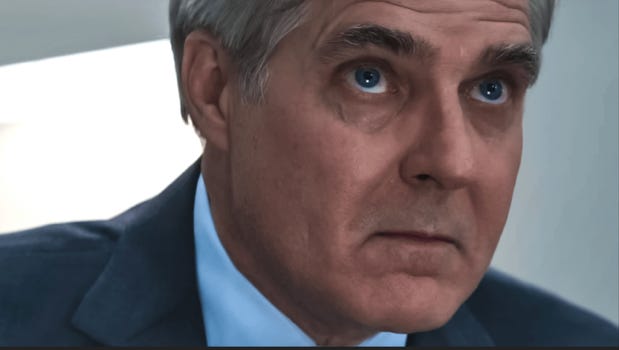
In Dead Reckoning Part One (the 2023 movie of the Mission: Impossible franchise) Eugene Kittridge (played by Henry Czerny) tells Ethan Hunt (Tom Cruise), “Our lives are the sum of our choices. And we cannot escape the past. Ethan, this mission of yours is going to cost you... dearly.” That menacing pause before “dearly” is what makes the scene.
But it is the first sentence that I found most arresting and relevant to a person writing anything biographical: our lives are the sum of our choices; my life is the sum of my choices.
Before I print that on my t-shirt, I want to take a look at it.
First, definitions. I imagine that all these infinitives are related to each other: to choose; to decide; to conclude; to select (as a course of action). They all signal the act of committing after considering options, alternatives, “two roads diverged in a yellow wood,” to quote Robert Frost.
The only option, other than committing to one and excluding the others, is to decide not to decide: to stare at the fork in the road, or to wait for the Stop sign to turn green.
The question is ages-old: Do we choose, or are we destined? Are we at the mercy of the heavens, or are we “at some time” masters of our fates “and the fault,” as Cassius suggested to dear Brutus, “is not in our stars, but in ourselves…”?
I found the Latin derivation of the word “decide” to be informative. This is from Word Origins:
Etymologically, decide denotes a resolving of alternatives or difficulties by cutting through them as if with a knife or a sword – dealing with them ‘at a stoke.’ The word comes, perhaps, via French decider, from Latin dēcidere, a compound verb formed from the prefix dē- ‘off’ and caedere ‘cut, strike’.
This question of fate versus choice was addressed in part by the Spanish philosopher Jose Ortega y Gasset in his work La rebelión de las masas (The Revolt of the Masses), published in Spanish in 1930, (English translation in 1932, authorized by Ortega), in the chapter “The Height of the Times.” He integrates destiny and choice beautifully, thus:
Destiny is not a kind of mechanism. We are not launched into existence like a shot from a gun, with its trajectory absolutely predetermined. The destiny under which we fall when we come into this world — it is always this world, the actual one — consists in the exact contrary. Instead of imposing on us one trajectory, it imposes several, and consequently forces us to choose. Surprising condition, this, of our existence! To live is to feel ourselves fatally obliged to exercise our liberty, to decide what we are going to be in this world. Not for a single moment is our activity of decision allowed to rest.
Next week I am writing about abundance mindset versus scarcity mindset, how each one affects our ambitions, our dreams and maybe literally our vision – our capacity for taking in information around us.
But for now I want to look at the analogy of cutting, pruning off future possibilities and committing to one branch, one path. The word “decide” is derived from the idea that for each one thing you decide to pursue, you are casting away a hundred other options. And each day, with each decision, you leave behind an ever-larger pile of closed-off paths.
The world of possibilities seems to be collapsing behind me.
Leaning into my visual side, I wanted to sketch my path so far on this earth, and to use this as a kind of worksheet to ponder how and to what extent possibilities expand or diminish as one moves forward.
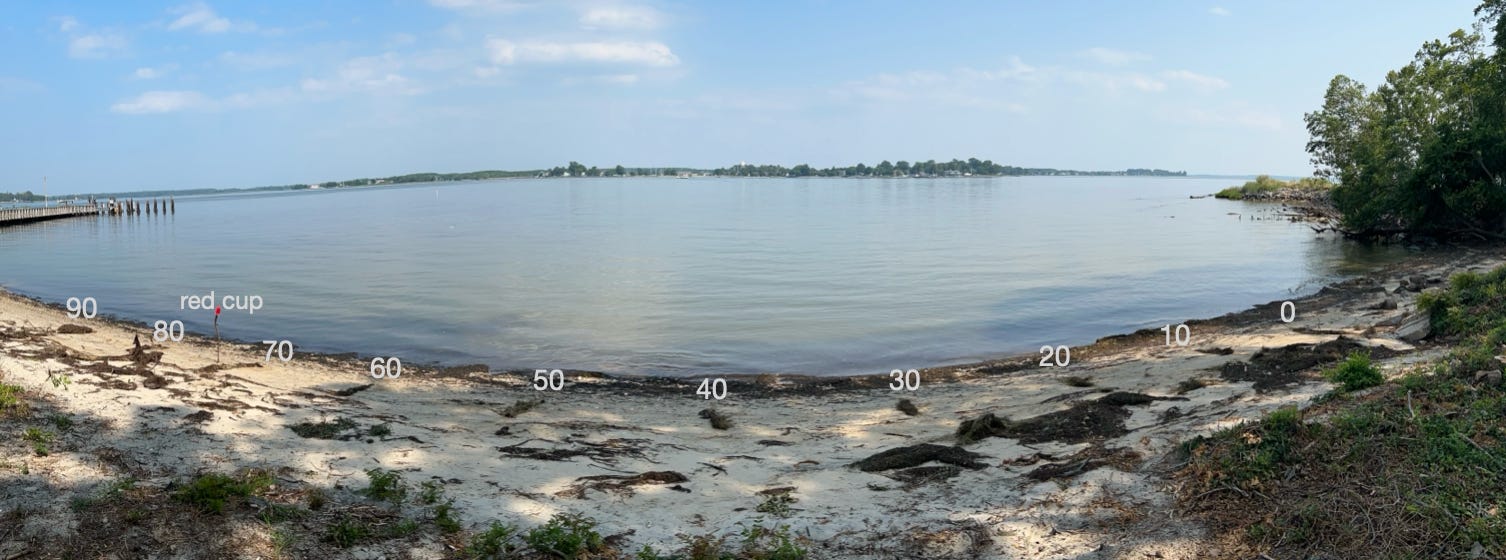
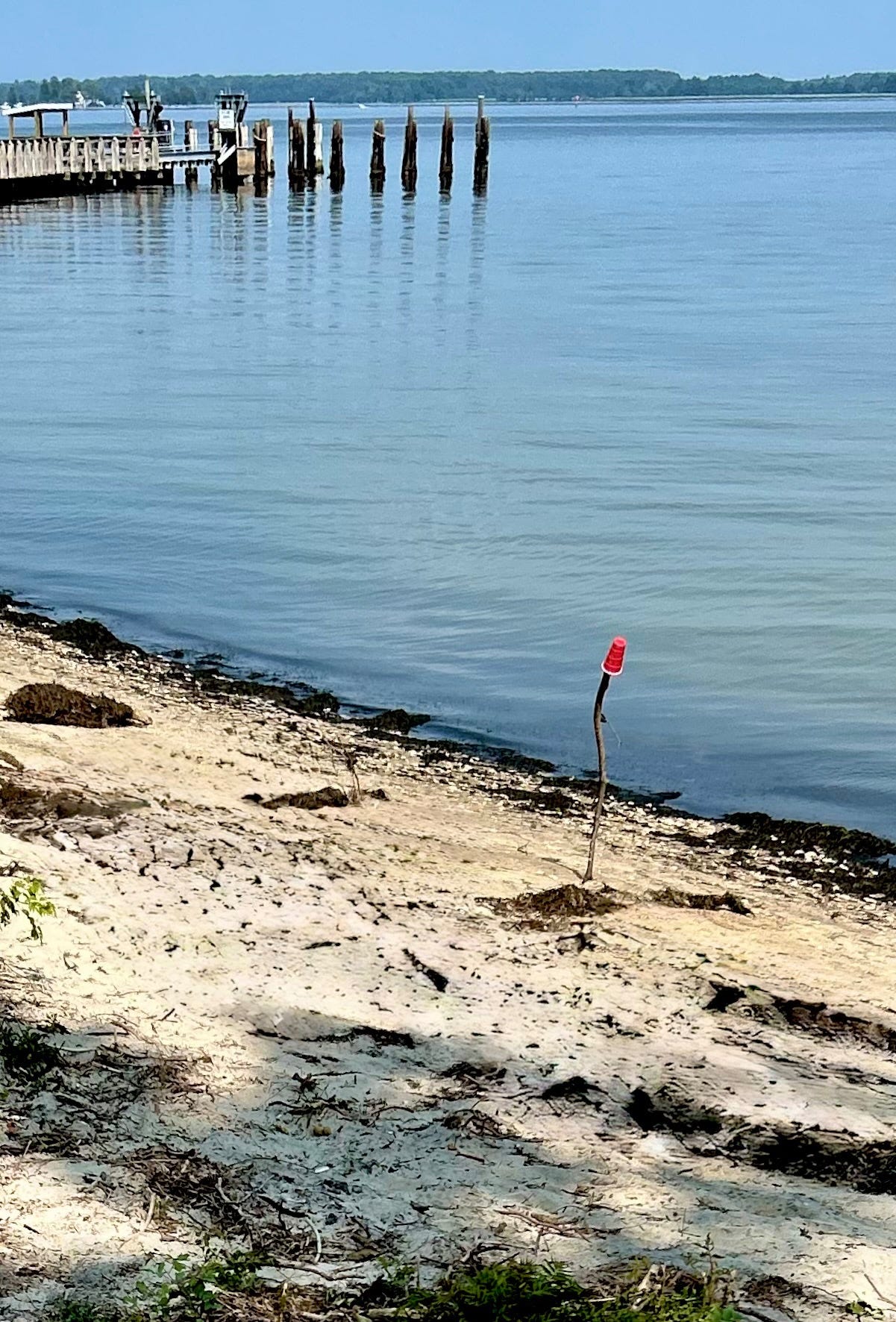
The ferry runs from Oxford, Maryland – a lovely village of old colonial-style houses on the east bank of the Tred Avon River – to Bellevue on the west, where there is a small sandy area to the right of dock. I paced off a timeline, starting at zero, with each step counting as two years; each decade was five steps. I gave myself a generous 90-year run, inshallah.
Do not worry, Gentle Reader, that I might take you through the analysis, describing each pace across the decades and back, marking turning points, critical events, and influential people; the transition from son to brother to uncle to father to grandfather; listing the colleges I did not get into, the romantic intersections, and a troublingly long list of musical instruments I have tried to learn how to play.
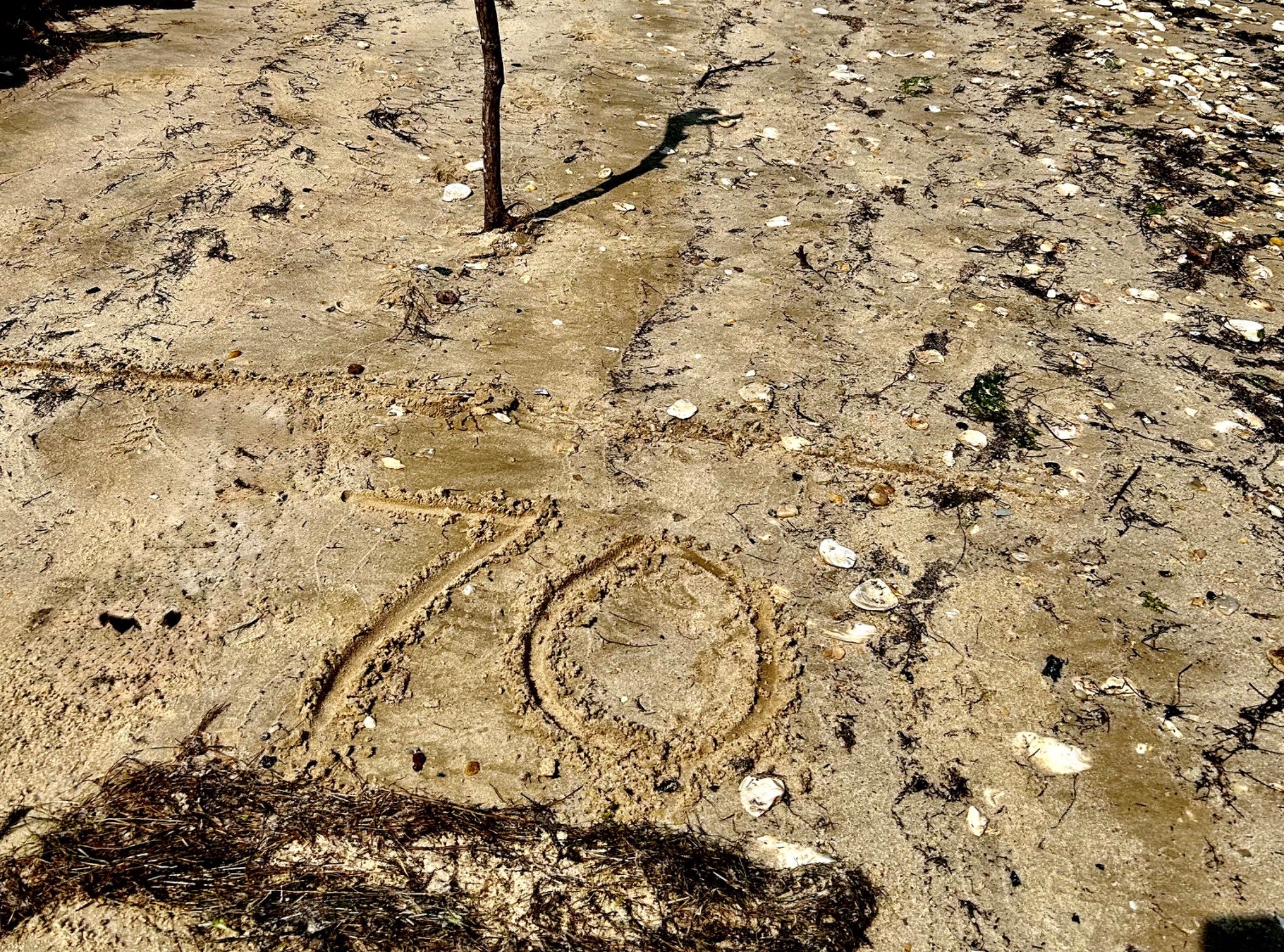
But here was the surprise. I had placed a large stick at 72 (my age this year) upon which I inverted a 16 ounce red Solo cup I had found. I stepped further inland to capture the timeline on my camera. My beginning was so far to the right I had to search to find it; meanwhile the red cup seemed disproportionately close to the finish line – only nine steps away.
A couple literary anchors come to mind. One is Four Thousand Weeks: Time Management for Mortals, a 2021 book by English author Oliver Burkeman, whose premise is that “the average human lifespan is absurdly, terrifyingly, insultingly short” and that on average we live about four thousand weeks.
Last week I wrote about the trap of verbosity – being in “conversations” with people who can’t or won’t stop going on and on. A couple I know went to an event, at which the husband was the subject of such verbal prolixity from a woman with a lot of information to convey. Always the gentleman and diplomat, he extricated himself and headed to the bar. Passing his spouse en route he whispered to her “4000 weeks…” – short-hand for “life is too short for these sorts of situations.”
Clearly a man taking charge of his destiny.
Related to this, daughter Molly recently reminded me of the poem A Summer Day, by Mary Oliver, which ends:
Tell me, what is it you plan to do
With your one wild and precious life?
I stood at the zero mark, looking out over the timeline. I had marked out the beginning of each decade with scarf-lengths of dried seagrass. The red plastic cup felt lost in the distance, although it was only some 24 yards away. Four steps away from 80, nine steps from 90.
What is it I plan to do with my one wild and precious life?
I do not want these next nine steps to feel increasingly bereft of choice. I want them to feel flush with color, and as full as ever of possibility.
Up the slope along the road there was an older gentleman slowly walking his dog. He sported white slacks, a light blue short-sleeved shirt and white canvas shoes. I wished he had had a hat on his fine, grey head as he walked through patches of sun and shade. His dog was a small, happy, white shape.
Suddenly, I hoped this fellow traveler never felt the need to do what I was doing. I wanted him to feel abundance in whatever was happening for him at this moment.
If he keeps a journal, I hope today’s entry reads something like:
That last hot Monday in July, I had a lovely walk with Ceci down by the dock. There was another fellow doing something or other near the water’s edge with a cup on a stick. He looked up and we waved to each other. I never know who I’m going to meet.
Reflections on a Red Cup
Your reflection on a life timeline gave me pause. Every once in a while I am made aware that the days ahead are far fewer than those behind. That realization is enough for me. The timeline is a bit graphic in pointing out the inexorable way to dusty death. Really? Only that much possible time left?
While I do see that our lives are the sum of our choices in many ways, I think they are much more. When I think of my life as a series of events, milestones, forks in the road, decisions on which path to take, a linear depiction is useful. As we look back it’s easy to see a line connecting those events. And when I look at the line of my past it isn’t very straight.
When I put myself at the Red Cup, the present, and look forward, that line is less clear. Rather than Frost’s pastoral metaphor of clear choice, I prefer to envision the growth of our neural network. As we move forward in life we’re often like a dendrite reaching out in intercellular space to find a new connection. While that dendrite makes this one synapse it also makes many others. The experience of life is a marvelous network of interconnections. Many of those connections are timeless. Through memory they exist in any given moment. We have chosen to define our lives by the clock, and are limited by a finite biological life, but while alive our experience is not always linear.
Even when we choose the path forward it may not limit the possibilities of the future. While I have viewed some of my life choices as having taken the path ‘no step had trodden black’, often I backtrack, revisit, circle back and try another route. Some experiences may be limited by time and opportunity, but many others are not. But of course if I have a clear goal in mind, or if I’m in a hurry, I hop on the interstate. Even then unforeseen circumstances may lead to a detour, hopefully it will be a new adventure and not waiting by the roadside for the tow truck.
Our fabulous human memory is what allows us to construct our life as a timeline and also to see it as a network of experience. I experience being unbound by the Red Cup of the moment most often when I am biking or hiking. The right environmental conditions, weather, smells, lighting will trigger memories that are then integrated into the experience of the moment. I am riding along a shaded Vermont road, the air is humid, the temperature mild, the sky clear, and the smell of earth fills my senses. At that moment I’m transported to a lane in Italy, 30 years ago. The experiences are connected for me in that moment, timeless.
Getting to the Red Cup has been rife with injuries and insults. At this vantage point the paths forward appear to be limited by the resulting aches and pains experience have wrought, and not by the pruning shears. If I ever end up on the other side of the dock, let’s go have a drink while we still can.
❤️ this, Stew. Your writing, questions, and visuals, remind me of a time earlier this month, when Brenan and I were sitting around a dying fire in our backyard after the last of the guests, and neighbors, had left. He spoke, which is uncharacteristic of him when he's sitting by an outdoor fire, saying, "Forty years. That's how long we've lived now, yet how brief it feels."
We hosted this backyard hangout in honor of neighbors who were about to leave for 6 months. It's a tradition we've had with them for the last few summers. During those three or so hours, we reminisced about how quickly time passes and things change (people come, people go). One of our mutual friends informed us of another friend's recent loss. Her mother had unexpectedly passed in her home a few days prior. Her mother's house is only a few blocks from ours.
The last two guests to leave were the youngest ones, Lucy (7) and Thorsten (11). As their dad, Eric, whistled from two yards down, signaling it was time for them to go to bed, and I watched them leave, I felt like I was in two places at once. One, where I've experienced this very scene the last few summers, but with younger versions of these two kids, and another, standing where I was, saying goodbye to them until we see each other again in six months. And it struck me, as it often does these days, that the one constant through this passage of human time, is the land around us; our backyard that bears witness and holds us. Much like the beach you chose to do your timeline visual on...