

I am culling my library. This involves going through books shelf by shelf and separating the “keep” from the “cull” — those volumes I could do without. I differentiate based on a simple question: "If I were to move from this house to, say, another house in another town, is this book worth the weight and the space it would require to move it?” I was surprised at the result of a mere half-hour of culling: 40 pounds of books, or one cubic foot — approximately what would fit in one of those moving boxes for heavy objects.
To do this task with any efficiency requires taking off the hat of sentimentality and putting on the hat of resolve and decisiveness.
The culled books now sit in two columns, each two feet high. I gaze at them with satisfaction and quickly notice a theme. Most of them are from my business library, from the time when I was a management consultant and executive coach.
Not surprising, I suppose; five years ago I went to the tiring-house of retirement1 to trade in my dress shirts, ties, suits and uncomfortable shoes for jeans, flannel shirts and walking shoes.
The “keep” pile comprises many business-related volumes, but I was struck by where I placed nearly all my books about managing change — in the culled stacks. Here are a few titles:
Immunity to Change: How to overcome it and unlock the potential in yourself and your organization
Switch: How to change things when change is hard
Change Anything: The new science of personal success
For those of you unfamiliar with organization development esoterica, there is a huge body of knowledge on change management: a large and sometimes unwieldy umbrella term for anything from how to bring about change in the corporate culture and how to smooth the adoption of new technology, to how to help your team navigate changing consumer demand and how to be personally resilient in the face of relentless change. As I said — a big umbrella.
I can always find this content somewhere if I need it. But I will lose the capacity to casually, aimlessly, flip through an actual book. Which is what I spent the next hour doing.
In my career as a training facilitator, I must have designed dozens of workshops on the topic of managing change. First, I would research the topic and distill what I learned. Typically I would find a visual model that helps summarize a complex topic.
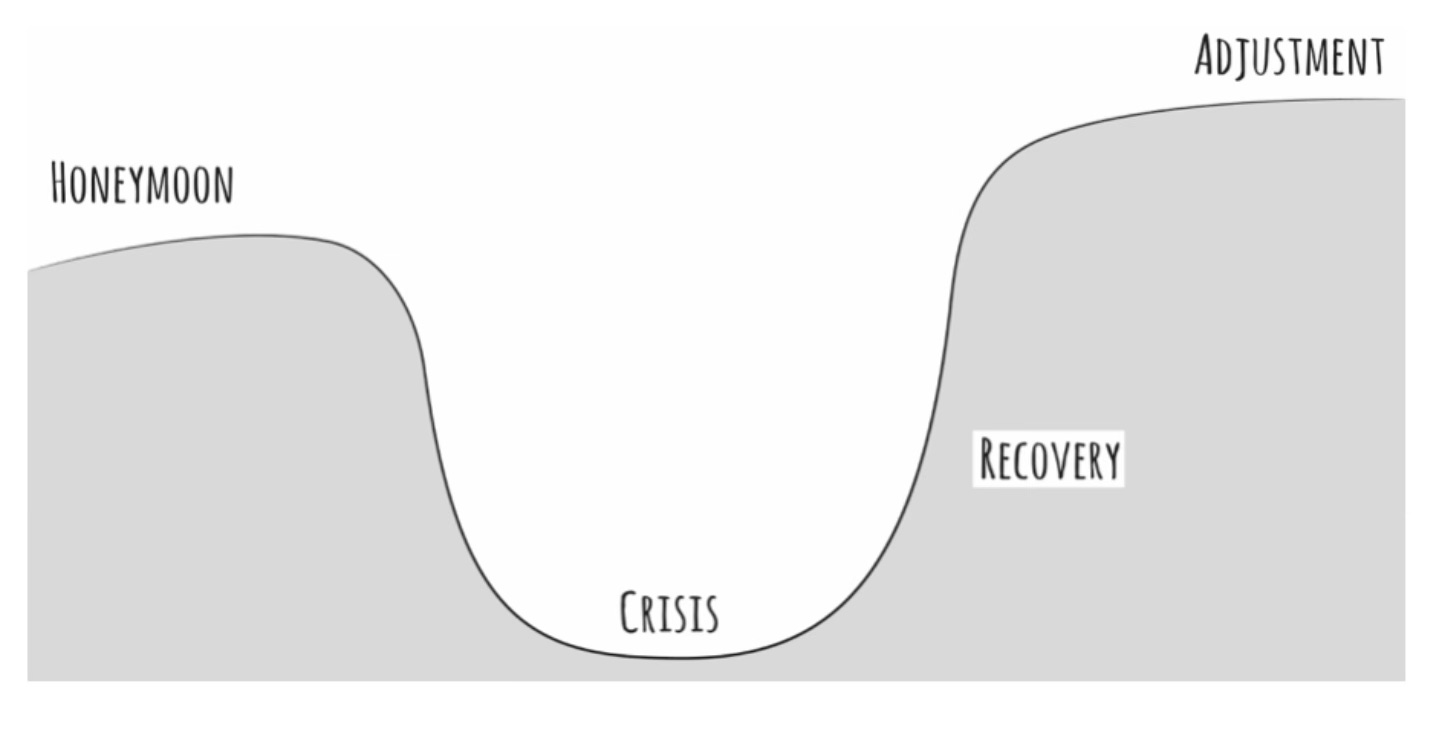
Above is the U-shaped curve theory by Norwegian sociologist Sverre Lysgaard. He was studying the phenomenon of culture shock, when Norwegian students go to live in another country. He describes the four stages this way:
Adjustment as a process over time seems to follow a U-shaped curve: adjustment is felt to be easy and successful to begin with; then follows a ‘crisis’ in which one feels less well adjusted, somewhat lonely and unhappy; finally one begins to feel better adjusted again, becoming more integrated into the foreign community.
Renowned psychiatrist Walter Menninger was contracted by the early Peace Corps to research the challenges faced by volunteers when they returned to the U.S. The Menninger Morale Curve was the result.
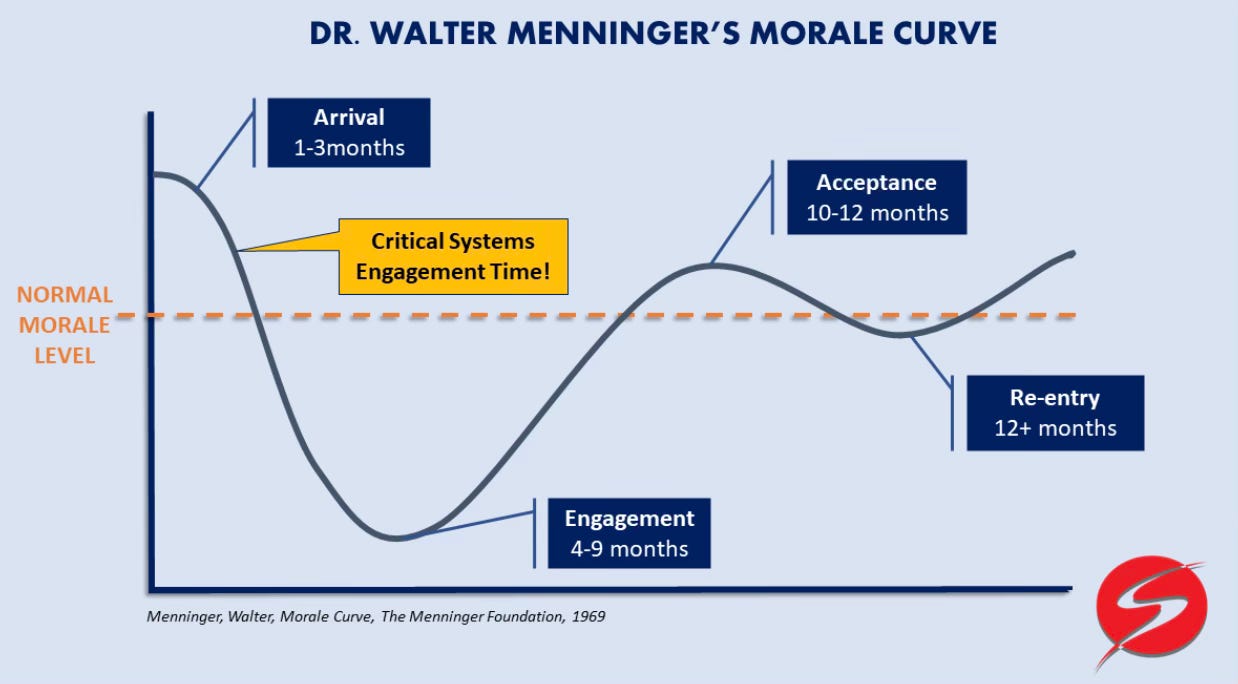
This idea of the variability of morale during time of change has many uses. In my own work this kind of framework helped remind leaders that their staff will go through phases of adaptation when confronted with organizational change, be it a restructure, a new technology, or a new boss. Good leaders help people through this process and don’t just assume “they’ll get used to it.”
Change can be disruptive and disorienting. This curved framework is also found in the five stages of grieving, as posited by Elisabeth Kubler-Ross.
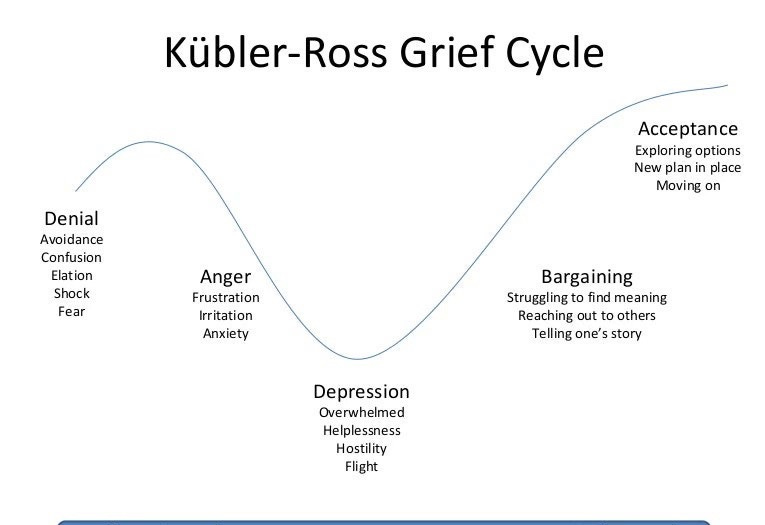
Over the years, I started seeing similar curves being applied to everything from personal change…
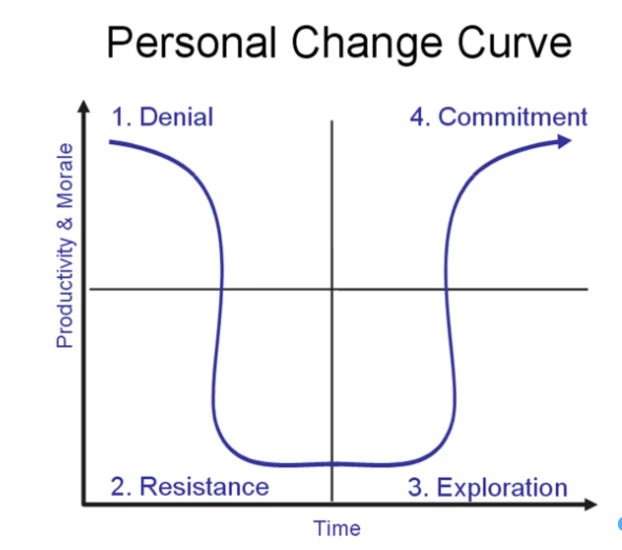
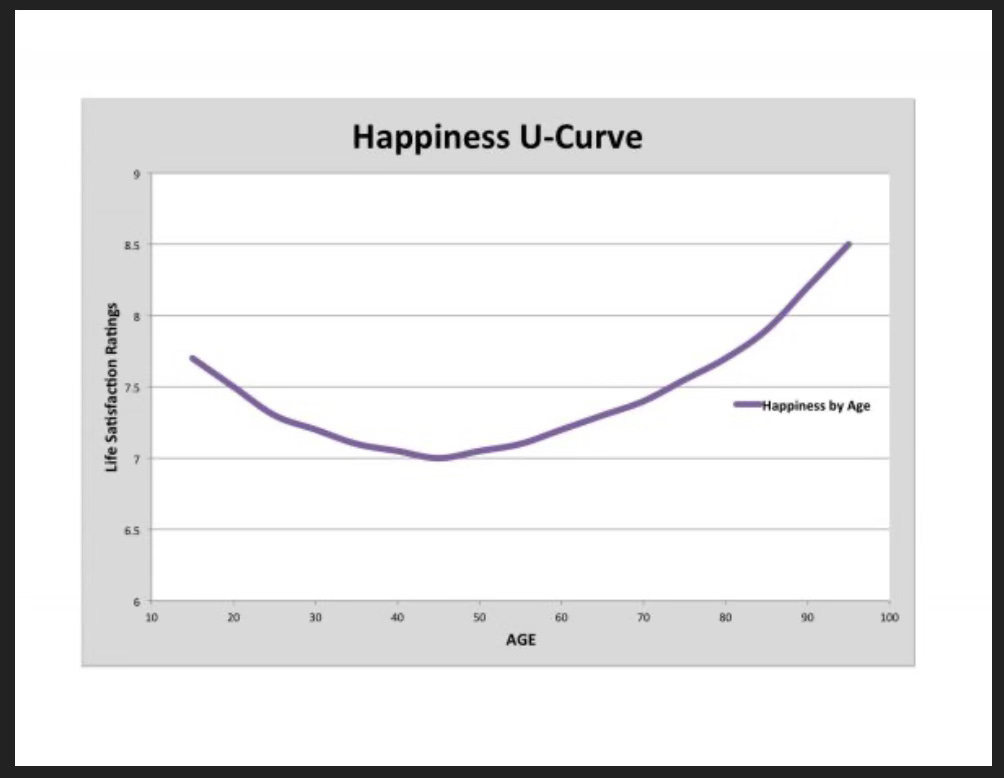
…to levels of happiness as a function of aging…
…to morale levels during 5-year surgical residencies.
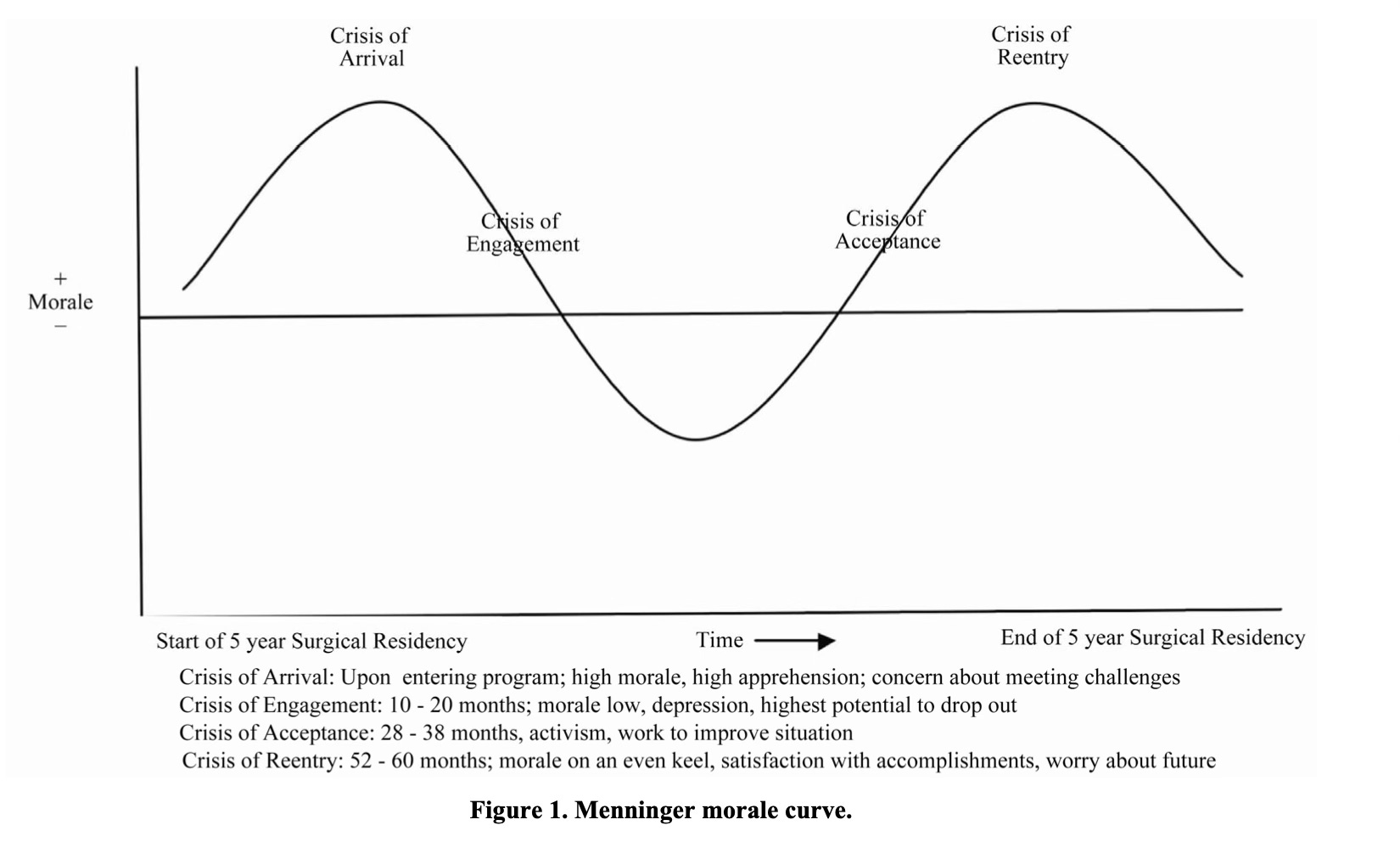
Allow me to paraphrase the small print at the bottom. You can imagine the applicability to so many situations in everyday life and learning:
Arrival: Characterized by excitement and high morale. “I can do this!”
Engagement: Reality hits home, morale falls. “What have I gotten myself into??”
Acceptance: Initiative and activism to improve the situation. “What steps can I take?”
Reentry: Morale on even keel, more satisfaction with accomplishments. “I’ve got this.”
Bottom line: it helps to know there are phases to the change process; it helps to know these phases are recognizable and “normal”; it helps to know the bottom of the U is not the end of the story.
So, why don’t I need these books anymore? Part of the reason is that thinking back I struggle to identify a single organizational “change effort” that was executed with anything approximating institutional aplomb.
Also, after years of executive coaching I begin to wonder: Do people really change in order to grow and develop? Or do they learn and find success by becoming more themselves, and working with what they’ve got?
At this point, I have to state the obvious — the feeling many of us have that we are on a downward slope as a democracy, not yet at — but apparently approaching — the bottom of a U-shaped curve. Except it feels like a tragic dismantling. It does not feel like a curve.
Yet. We start to feel the rising side when we see the result of protest, when we spy again the guardrails of our rule of law, when we despair less (“What is happening to us?”) and hope more (“Where do we have the power to make a positive difference?”) — to bring back some light, some sense of justice, some greater measure of the best we can be as a nation.
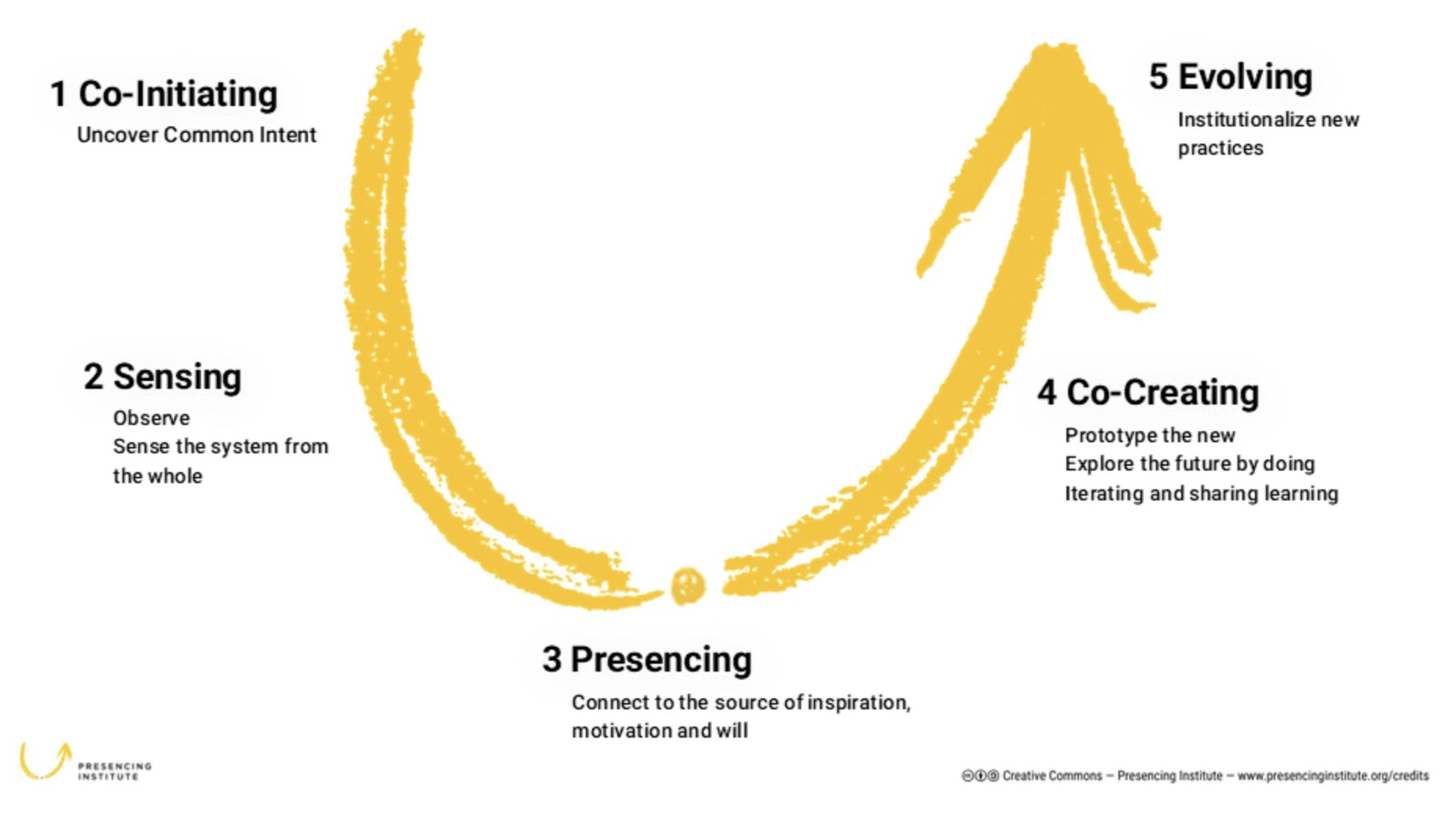
I am keeping Otto Scharmer’s book entitled Theory U. It is a huge, complex volume and very heavy. The way he describes his U-shaped curve gives me hope:
As we move down the left side of the U, we allow ourselves to connect with the world outside our bubble. Reaching the bottom of the U, we suspend our common assumptions and thinking, letting come our highest future possibility. Finally as we ascend the right side of the U, we bring forth the new into the world.
Some days I am hard pressed to imagine the upward side of the curve. But I have to believe it is there.
The term “tiring-house,” first used in 1590, refers to the area backstage where actors change costumes during a play. Related to the English attire (from Anglo-French atirer, to equip, prepare). Probably not related to the etymology of retire (from Middle French retirer, to withdraw), but I wanted to use both in the same sentence.
Note
Otto Scharmer is a senior lecturer at MIT
Stew, the repetition of the u-shaped pattern here is pretty astounding. I have to wonder (do you know?) if each of these scientists thought they were coming up with something original.
I've felt for some time that what we are experiencing politically and socially is analogous to giving birth. There is a point in most labors often described as the hardest part. It may cause a sudden loss of confidence, with feelings of being overwhelmed, fearful, or wanting to give up. They call it "Transition." Not long after, the actual work of delivery gets going, giving the mother something to work towards and focus on. With effort and a touch of the miraculous, a new being is born.