

I was thinking about short, catchy messaging - you know, the clever phrase with a rhythm or perhaps rhyme that gets your attention. The first one to come to my mind? Not something from Twitter, or a recent political campaign. But to me it exemplified the ad-like jingle quality applied here to an international dispute:
“Fifty-four forty or fight.”
I can hear the incredulous: Seriously? Top of mind is a political slogan from James Polk’s presidential campaign of 1844?!
You have to admit, it’s catchy - short, alliterative and a call to action. This unit of cultural information was termed a slogan. Now it would be called a meme.
A brief visit to Wikipedia told me a couple things. First, it apparently was not a campaign slogan, but was coined a few years after regarding the “Oregon Question.”
The second point is the profound complexity related to that catchy phrase. Expansionist ambitions in the region in the early 1800s included the U.S., Great Britain, Spain and Russia. The region in question was the territory west of the continental divide between the 42nd parallel — a line of latitude marked now by the northern border of California — and the 54°40’ parallel (54 degrees 40 minutes) which was the southern border of what was then called “Russian America.”
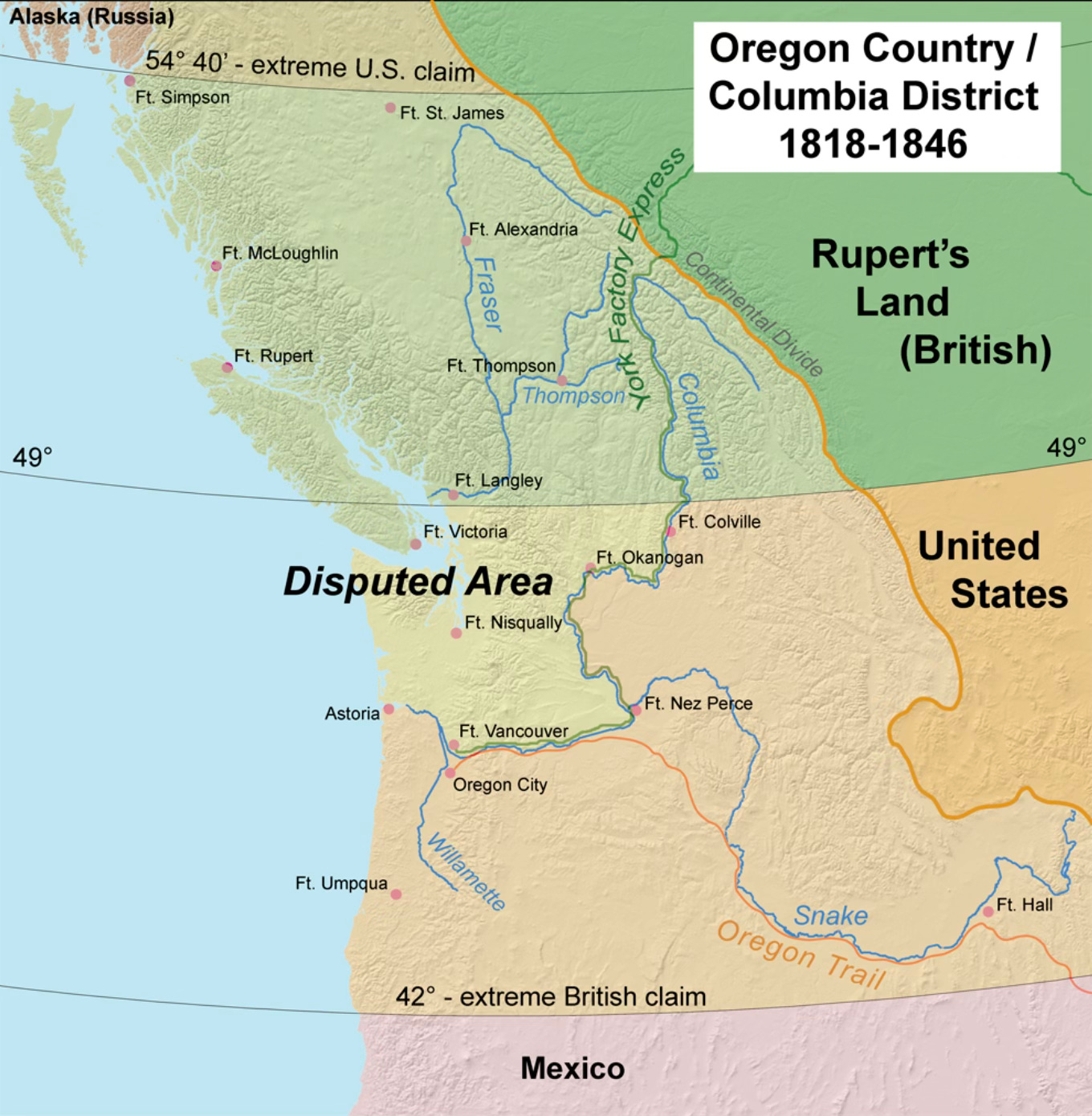
After the war of 1812, the dispute was down to two parties — the U.S. and Great Britain. “Fifty-four forty or fight” reflected the American sentiment of the time — either we get the territory we want or else… More on Manifest Destiny coming up.
The compromise — for those on the edge of your seats — was to draw the line at the 49th parallel, which to this day marks the northern border of the U.S. from Washington to Minnesota.
And that, ladies and gentlemen, is how two imperialist powers resolved the dispute over land inhabited for over 10,000 years by the Chinook and 29 other tribes of Indigenous People. (See map below).

“Fun” fact: You will not find the Chinook on the above map because they are not a federally recognized tribe (although in 1962 The Army liked the name enough to brand the new heavy-lift helicopter The Chinook.) The Department of the Interior recognized the tribe in 2001 at the end of the Clinton administration. Eighteen months later, political appointees of George W. Bush revoked the recognition. Attempts to re-establish the Chinook as a tribe since then have been unsuccessful.
But that’s a small matter compared to the responsibilities of Manifest Destiny. There is a lot bundled into this bumper-sticker of a meme.
According to Wikipedia: “Most historians credit the conservative newspaper editor and future propagandist for the Confederacy, John O’Sullivan, with coining the term manifest destiny in 1845.” O’Sullivan was arguing for the right of the U.S. to claim all of disputed Oregon territory. As he wrote:
And that claim is by the right of our manifest destiny to overspread and to possess the whole of the continent which Providence has given us for the development of the great experiment of liberty and federated self-government entrusted to us.
So, basically, “Manifest Destiny” is not only memorable and fun to say — with the repeated “est” sound, kudos to Mr O’Sullivan!1 — it has all the characteristics of a fabulous call to action. It is obvious (“manifest’), and certain — as inevitable a destiny for our young nation as Lorraine Baines was for George McFly in Back to the Future (1985).

Throw in for good measure: 1) the unique moral virtue of the new nation, 2) a mission to redeem the world, and 3) a belief that success in spreading the American way of life is divinely ordained2 and you have either a real conversation stopper or a new recruit. The Almighty is in on this? Sign Me Up!

The above image touches on several themes we have covered. The caption to this iconic graphic in the Wikipedia article on manifest destiny reads:
“American Progress” (1872) by John Gast is an allegorical representation of the modernization of the new west. Columbia, a personification of the United States, is shown leading civilization westward with the American settlers. She is shown bringing light from east to west, stringing telegraph wire, holding a school book, and highlighting different stages of economic activity and evolving forms of transportation. On the left, Indigenous Americans are displaced from their ancestral homeland.
The Oregon Question was a long time ago. It seems, however, that a sense of exceptionalism lives on in some hearts and minds. The idea of woe to the conquered has been around since Thucydides: “the strong do what they can and the weak suffer what they must.” That could be the modus operandi of any imperial cabinet.
“Might Makes Right” is catchy. Emotionally charged. Decisive. Simplistic. Avoids nuance, context, and moves right to action.
Back in the 1800s our rightness and might-ness got us the western states. What’s the next frontier? Sky’s the limit.
Next up, we take a look at The Bay of Pigs: a case study in strategic leadership and failed assumptions, by Vincent Dueñas…
Notes:
Bay of Pigs case study from May 2, 2017
Apparently there is some dispute as cited in Wikipedia: “Other historians suggest the unsigned editorial titled “Annexation” in which it first appeared was written by journalist and annexation advocate Jane Cazneau.” A male given credit for something a woman wrote? How likely is that?
A summary of the three tenants of manifest destiny according to historian William Earl Weeks in his 1997 book Building the Continental Empire: American Expansion from the Revolution to the Civil War
This one felt dense to me, Stew, probably because I've never been the best student of either American history or geography. I didn’t know the history of the Chinook recognition at all, and reading about how casually it was granted and then revoked left me with that familiar, sinking ‘oh right, this is how power works’ feeling.
What really struck me was how much of this history runs on language that feels engineered to be remembered. “Fifty-four forty or fight.” “Manifest Destiny.” Short, rhythmic, confident, doing the work of persuasion before we ever get to the substance, something a certain someone is masterful at, though it pains me to use that adjective. The assumption that desire plus strength equals legitimacy, that inevitability can be asserted rather than argued, treated as justification in itself. Ugh!
And it’s hard not to notice how keep repackaging the same ideology.
Always enlightening! Thanks Stew for another great read!
I can always count on learning something I never knew before.
I love the surprise factor too!