

The father held the baby in one of those front-facing slings. The mom was tending to two others — a boy one and a half years old and his sister, maybe two and a half. Some thirty passengers were in the shuttle tram at the airport, and I had the five-minute ride to study three levels of self-awareness.
The girl squiggled in her seat, trying out all the possible positions and checking on her mom’s reaction. The boy stood by his dad’s leg, pacifier in mouth and a diminutive but comforting blankie in one hand. The look on his face seemed to say “well, this is new; thank goodness dad’s here.”
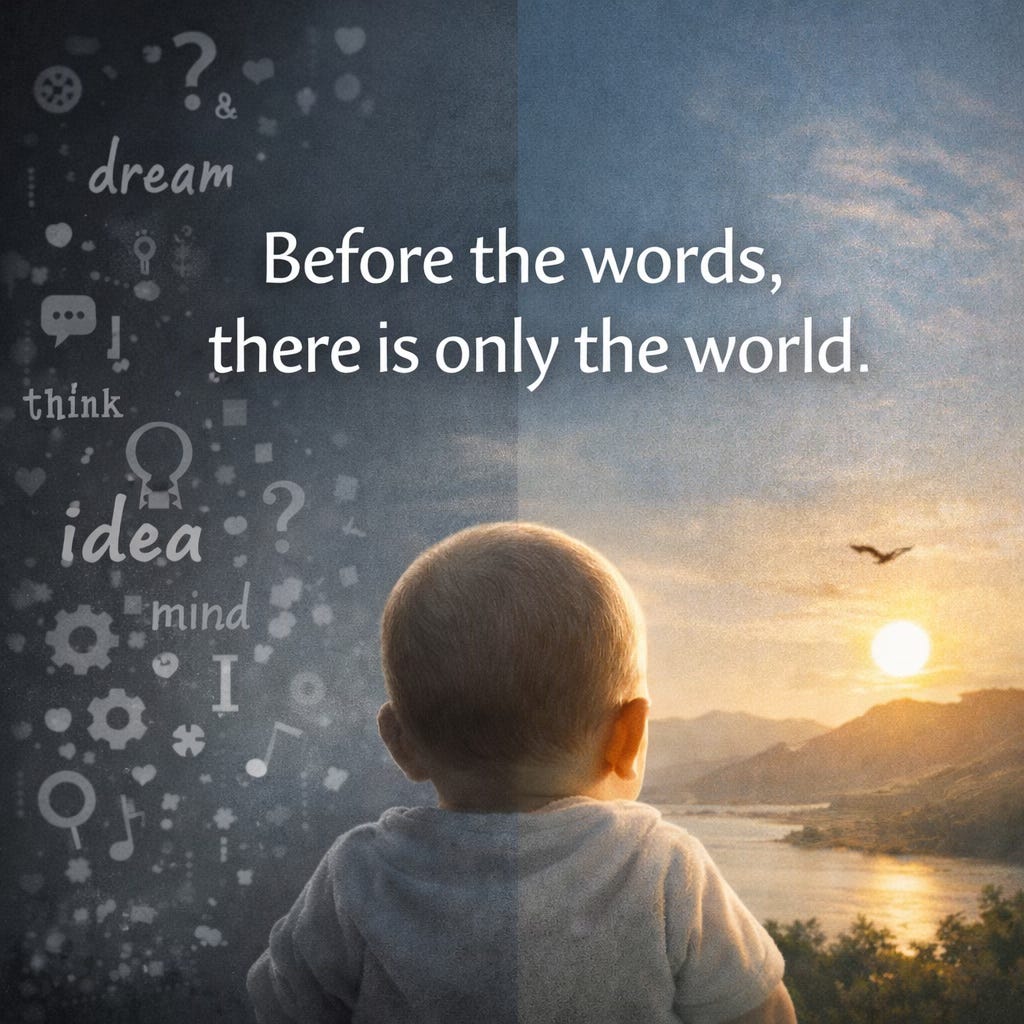
The baby was looking out at the world. Did he know, at the tender age of three months, that there even is a world? With his cherry-blushed cheeks and unblinking eyes, the baby’s visage was one of unalloyed consciousness where there is no me, no you, no airport — there is only this moment.
In summary:
Girl: What are all my options for sitting?
Boy: Dad here? Check. Mom here? Check. Safe for now.
It occurred to me that I didn’t know how to represent the mind of the infant. Since the time we become verbal, words are so ubiquitous, so necessary, so…..useful. But words didn’t help here.
Before young humans become verbal — understanding and speaking in order to express themselves — what do their thoughts consist of? It is difficult to reconstruct the state of affairs behind the eyes of that buddha baby.
Melanie Mitchell is a professor at the Santa Fe Institute, and an expert in artificial intelligence and cognitive science. She was interviewed by Meghna Chakrabarti (“Brainwaves: is AI really thinking?” NPR’s On Point, Feb 11, 2026) and she had this thought about thinking:
There were many people who believed that language and thought were the same thing, and that thinking was a logic process. A process that maybe was reflected in our language as we spoke, that we were expressing our thoughts. And it was all at a conscious level. And when we were solving a problem, we were going through the logical steps of solving the problem.
And that was how AI was created back in the beginning of the field in the 1950s and 1960s. It was all modeling human thought on logic, the steps of rational, logical deduction. But that didn’t work.
It didn’t work because to teach a computer to think in this way would require an impossible amount of code. More effective apparently is to train a system to scour the universe of words on the internet and thereby “teach itself” how to build a coherent response to a prompt by accurately predicting the next word. (Novice disclaimer: Already in over my head, I get the sense that “next word prediction”1 is only part of how Large Language Models work.)
That is how the AI today seems to have such a good grasp of language. Program in some other characteristics (like agreeableness, expression of empathy and encouragement) and you have a very human sounding verbal response to a prompt or question.
But thinking and putting your thoughts to words is very different than mimicking human coherence. Dr. Mitchell explains:
We have a lot more going on in our brains than just predicting the next word. And that’s something that’s very different between how we think and how these machines behave. And language models are passive. They’re fed all this text, they predict the next word. They get some feedback that says right or wrong, and they don’t actually interact with the real world. It’s only the world of language.
So a thought is not words. Consciousness is not a running narration of what we experience in any moment. Once we start to use language, we glom words onto thoughts so quickly we barely are able to distinguish the thought we have put into words and the thought itself.
Anil Seth, a professor of neuroscience at the University of Sussex in England, makes the distinction between an algorithm (a mathematical recipe for doing stuff) and consciousness:2
It’s fundamentally about being, it’s about feeling, it’s having an experience of redness or of pain, the taste of ice cream or the sound of children’s laughter.
That, I believe, is what the baby was experiencing. His consciousness was stirred by the sights and sounds of the airport passengers — in particular the two familiar forms he saw moving nearby, which were his brother and his sister. No words to describe it. No sense of this is me, and that is the world. Just an experience, a taking in of stimuli, a stirring in the young heart and mind.
Words come later. That’s when you “put into words” what you are thinking. But first you need feelings, sensations, emotions. Even the word “emotion” comes from Middle French, emouvoir: to stir up.
“Not Ideas About the Thing But the Thing Itself” is the final poem in The Collected Poems of Wallace Stevens (1954). It describes this very idea, that the external reality of experience and the language we use to describe it are distinct. Here is an excerpt:
At the earliest ending of winter,
In March, a scrawny cry from outside
Seemed like a sound in his mind. …
It was not from the vast ventriloquism
Of sleep’s faded papier-mâché …
The sun was coming from outside. …
It was like
A new knowledge of reality.
Alan Watts, the British philosopher and theologian, recognized that we put words to experience so automatically and quickly that we assume thinking is verbal. Before articulation is experience, or as he put it in his book, The Wisdom of Insecurity, “The menu is not the meal.”
And still, and still…
Words can create their own experience and stir our souls.
A few days ago I saw Something Rotten! — a brilliant 2015 musical put on by students at St. Andrew’s Episcopal School where my pal Ritchie is the drama teacher. It’s got everything —Renaissance costumes, Shakespeare, dancing, intrigue, and spectacular musical numbers, all delivered with courage, confidence and joy. It was a delight.
In the first half, the new lovebirds Nigel and Portia share a song3 about their love of words. The refrain goes like this:
I love the places that words let me go
I love the way that your words move me so
I love that you feel the same way I do
And I love
The last line cuts off like that throughout the song.
It’s easy to predict the next word.

The Surprising Power of Next Word Prediction: Large Language Models Explained, Part 1 by Matthew Burtell and Helen Toner Center for Security and Emerging Technology
“Brainwaves: Are you in there? NPR’s On Point, Feb 10, 2026
“I Love the Way” from the musical Something Rotten! Lyrics by Wayne Kirkpatrick
Stew,
I have been enjoying your essays here. I love the way you enter this one, making an utterly quotidian moment into a catalyst for deep thinking about thinking. My own moments of what feels like cognitive vacancy, when I am not noticing any words or thoughts in my mind but I am melted into the world that envelops me, are perhaps the way I recapture "baby mind." I will try to enjoy those moments in this way now and embrace my capacity for utter vacancy.
You said you have a feeling there's more to it than next-token prediction, and then immediately nailed the other piece: program in agreeableness, i.e. what response would a human like best. You nailed it!
But you should read this: https://transformernews.substack.com/p/the-left-is-missing-out-on-ai-sanders-doctorow-bender-bores
Academics seem to have gotten kind of stuck talking about how LLMs don't really think/understand/create, they're just parroting humans etc. The folks who are taking AI seriously have largely fled the academy and gone to industry, so the only people left for NPR to interview are skeptics. At the point an LLM is able to mimick me well enough to do my job, I'm not really gonna care whether it "understands" the emails it's writing.