

Doing research used to involve actual footwork. Not everyone can relate to this, but library buildings used to be the place you went to dig deep on a topic.
For instance, a trip to the library was essential to answer the question: What was the cause of Hamlet’s delay in avenging the death of his father? And if that question was the subject of your senior high school research paper in Mr. Curtis’s English class, you might spend the better part of several days in a library, pulling books and filling out 3x5 index cards. You would write down one idea per card, and a reference number for the source in the upper right hand corner…
I’m losing some readers now I can tell. My point is that today we have lost the association of research with physical work involving buildings, card catalogues, “shelves” of “books,” and index cards. Lots of index cards. Lots of pencils. Starting in high school all the way through grad school: 1971-1983.
Nowadays, without any of those objects, without leaving home or even this chair, I can find out the tallest office building in the world (the Burj Khalifa in Dubai, UAE at 2,722 feet and 160 floors). But the largest office building by sheer space is the Surat Diamond Bourse in Gujarat, India — at 660,000 square meters, finished in 2023.
That’s slightly more than the office space of One World Trade Center, the Empire State Building and the Chrysler Building combined.
For 80 years prior to the Gujarat construction, however, the status of the largest office building in the world — standing 77 feet in height with a floor space of 620,000 square meters — belonged to one of our very own: The Pentagon.
I drove past it many mornings on my way to the USAID Training Center then located in Crystal City, Virginia. In many ways The Pentagon is unremarkable — such a low profile as viewed from US Route 1 you might miss it altogether.

But it is there, huge and way too heavy for Abby Hoffman to levitate it in 1967, even when accompanied by the Tibetan chants offered by Allen Ginsberg.1
In the early teens, there was a survey that put this question to a random sample of the US populace: What percentage of the federal budget does international development represent? Hard to say what went on in the respondents’ minds, but the average number they came up with was something like 20%.
It was actually .3%. That is three tenths of one percent of the federal budget. If, for example, a South African billionaire vowed to reduce US government spending, it is hard to argue that starting with USAID was anything other than ugly, horrific and stupid.
When I worked with USAID in the early teens, the 3-D model US foreign policy seemed to hold sway. The three Ds were Defense, Diplomacy and Development and were considered by some to have equal importance. Diplomacy and providing foreign aid and assistance are both ways of building partnerships with other nations. If we are not helping to lift up the low-income nations, then some other power — say, China — will fill the gap.
But back to the numbers.
In fiscal year 2024 (the most recent full year of data), the U.S. Department of State spent about $38.8 billion according to USFacts.2 That represented roughly 0.6 % of total federal spending — out of a total federal budget of about $6.75 trillion.
So, let’s see…USAID (.3%) and the State Department (.6%) combined were around 1% of the federal budget. That’s the diplomacy and development side of the 3Ds.
Defense? Well, here again I was surprised. In FY 2023, Department of Defense spending constituted 13.3% of the entire federal budget, and nearly 50% of the discretionary budget.3
Seems like a lot.
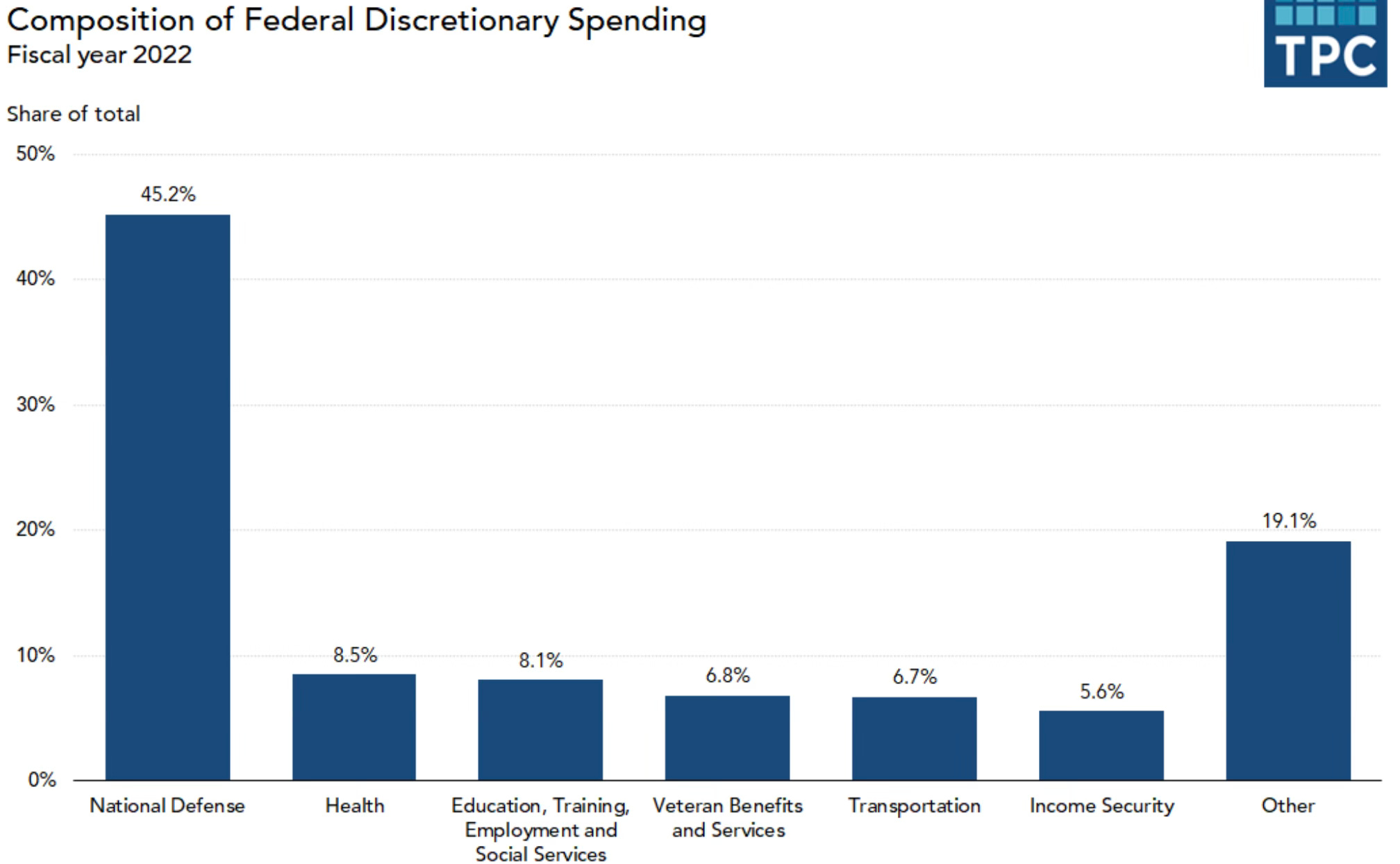
Costs of War, a research project of Brown University’s Watson School of International and Public Affairs, is an excellent resource for information on the economic, human, environmental, and social costs of US wars and military spending. Their research estimates that US wars since 9/11 (Iraq, Afghanistan, Syria, Pakistan, and related costs) have totaled around $8 trillion or more.
See, that’s the thing about research. I have not left the chair I was sitting in at the beginning of this post and I learned:
Veterans Affairs are listed separately in the federal budget
There is no line item for the costs of any particular war, so there is not an easy way to tally what war in general costs us taxpayers
Since 9/11, most of that $8 trillion in spending has been put on the national credit card.
Recently I attended a live streamed panel discussion hosted by the Watson School. One of the panelists was Linda Bilmes, a public finance expert and Senior Lecturer in Public Policy at the Harvard Kennedy School. She termed the phrase “ghost budget” to describe the budgetary sleight of hand to cover our costs without anyone really noticing. From the Costs of War website:
The post-9/11 wars were funded largely through debt, rather than through increased taxes or the sale of war bonds, as U.S. wars of the past were funded. The use of debt rather than increased taxes makes war more invisible to taxpayers, obscuring the true costs of war by pushing financial obligations to future generations. Moreover, increased public debt results in higher interest rates economy-wide, which can hamper business investments and make life more expensive for individuals and families.
So let me see if I’ve got this. Instead of raising taxes or selling bonds like we used to do to pay for wars, Congress uses supplemental appropriations (aka, you’ll love this, “Overseas Contingency Operations”). These OCO funds are almost entirely deficit-financed. Farhad Omar’s Substack “The Credit Card War and the Dollar’s Dilemma” characterizes this trend since 9/11:
Multiple administrations fought prolonged wars almost entirely through supplemental appropriations that bypassed the regular budgeting process. Congress quietly added trillions to the deficit without hard votes or public debate.
Emphasis mine.
There is a big dollar difference between paying for a standing army and paying for a war. The first cost is its own line item so to speak, but the second cost is buried in the uptick of another line item: Payment on the National Debt, which currently is 13% and rising.
The costs of war are muddled into the debt, the debt into interest payments, and the interest payments into “mandatory spending.” So by the time you ask “Can we cut this cost?” the answer is “We already spent it.” And now we have to pay interest on it.
The totality of the costs of war is like driving past The Pentagon on US Route 1: you hardly know it’s there.
Now I need to levitate myself out of this chair and shovel some snowcrete4 — something I can see and feel.

In a symbolic act during the 1967 March on the Pentagon, Hoffman said he would levitate the Pentagon, when it would turn orange and start to vibrate and, not incidentally, end the Vietnam War.
USFacts is rated highly in terms of objectivity and non-partisanship. Correct me if you think I am wrong on this. Here are their numbers for the Department of State.
USFacts article on military spending
Snowcrete is a portmanteau: a combination of the words “snow” and “concrete,” which describes snowpack so dense and heavy people can stand on it and not fall through. Sintered snow acts like a solid thanks to inches of sleet that fell, then froze during Winter Storm Fern and the days of frigid temperatures that followed. Baltimore Fishbowl News article by Aliza Worthington, Feb 3, 2026. “Sintering” is the process of compacting and forming a solid mass of material by pressure. I had to look it up.

Great piece, Stew. I hate the lying, the covert manipulation of money we don't have. I don't want to give one cent to this disgusting joke of an administration. The USAID debacle? The orange goon is a monster, a hateful, arrogant piece of crap. We have starving, homeless people in this country. We have a medical system that is so dysfunctional and overpriced that no one gets good care, except for that fabulous 1%. I'm so fed up, not just with this administration, but with the ones that came before. We don't know what's going on behind the scenes. And they lie to us in the name of "national security." Our governments should be 100% transparent, and accountable to us. They have to be reminded that they work for us. Their mission is to do the right thing. Not the thing that will generate illegal wealth as the monster helps himself to whatever he wants, and no one is stopping it. And yes, I second what Elizabeth Beggins said. I want to hear more about your experience when you worked for USAID. I know my post is an emotional rant. Because I'm an emotional person driven by my moral compass. It's enough already. It's got to implode. Hopefully sooner than later. xo
I wonder if you can hear me shrieking from where you're sitting...or shoveling. I know little about defense spending and probably less about how defense budgets are compiled or campaigned. Someone very close to me used to complain about how the less fortunate were too dependent on government handouts, never reckoning with their own use of VA benefits, Social Security or Medicare. This is illuminating and prompted me to read more deeply, which then made me realize more fully how little I know!
I'd be curious to know what you think about this, if you have time to delve into it.
https://www.ineteconomics.org/perspectives/blog/trillions-for-war-pennies-for-people-how-soaring-military-spending-fails-americans
Wealth disparity raises my hackles more than most topics. I realize tax reform conversations can get radioactive pretty quickly, and I realize that changing how the billionaire class is taxed won't solve our debt issues by themselves. But refusing to look at all the available options limits the policy toolkit to cutting spending alone, which means touching either entitlements or defense if you want serious deficit reduction. No matter which side of the aisle you're on.
I also want to know more about your work with USAID. :) Thanks, Stew.